Black Wall Street District On The Move.
What began as a community in Tulsa has become a global call for equity.
When the Black Wall Street movement first rose from the ashes of the Greenwood District in Tulsa, Oklahoma, it symbolized both devastation and resilience—a reminder of how Black wealth, enterprise, and self-determination were systematically attacked, yet never destroyed in spirit. Now, over a century later, that legacy is expanding across the globe. The recent announcement of Black Wall Street Australia, inaugurated with a commemorative seal and a public declaration of solidarity, signals an historic step in linking African American, African, and Indigenous struggles under one economic, cultural, and spiritual banner.
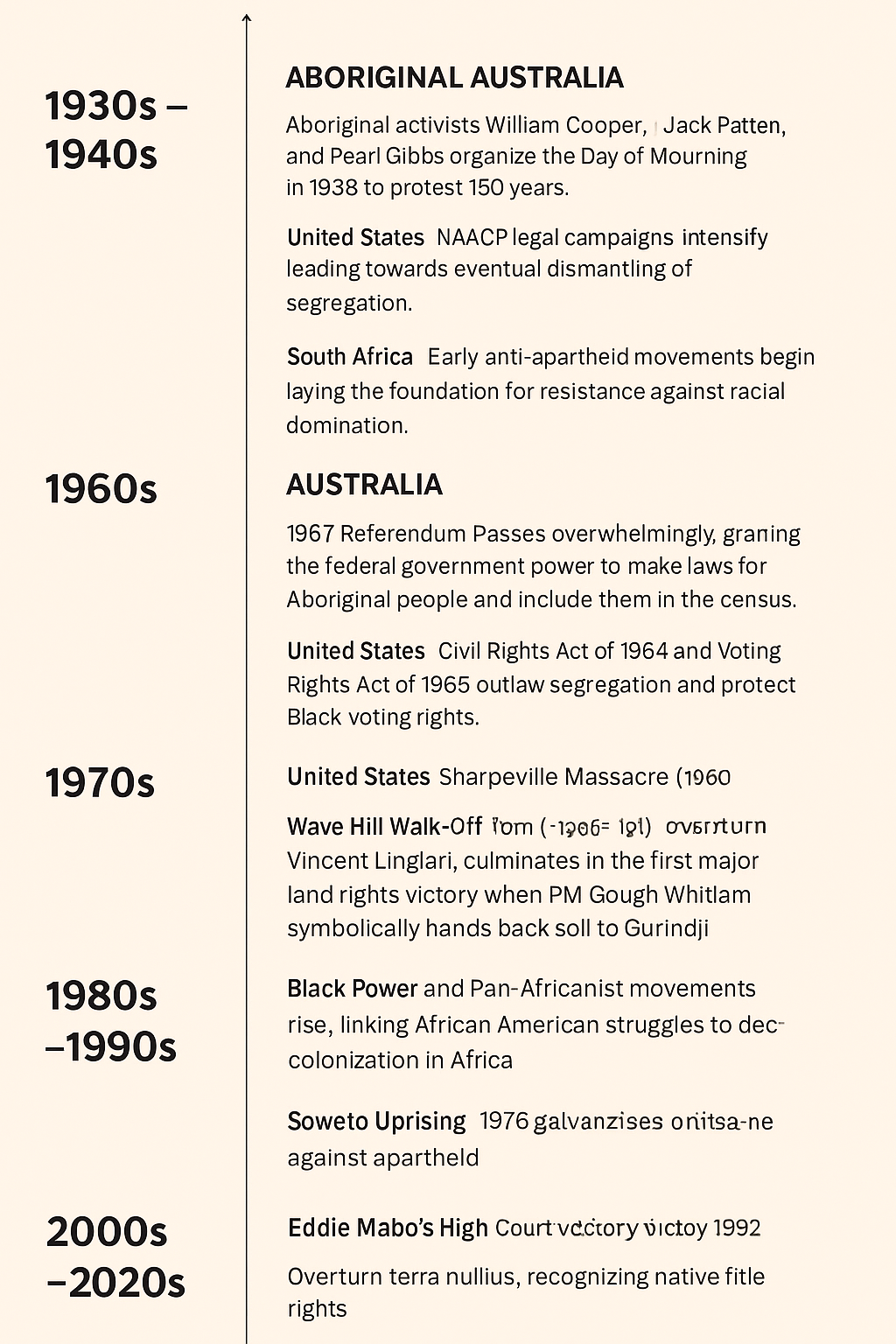
The initiative situates itself not merely as a chapter in a global nonprofit network, but as a profound civil rights milestone. It bridges past and present, Tulsa and Sydney, Jim Crow and apartheid, the U.S. Civil Rights Act of 1964 and Australia’s 1967 referendum recognizing Aboriginal peoples in the national census.
A Legacy of Resistance Across Continents
Dr. Michael Carter, Sr., President of Black Wall Street USA, reflected on the significance of this new chapter:
“What began as a community in Tulsa has become a global call for equity, ownership, and liberation. The establishment of Black Wall Street Australia is not only an act of remembrance but also an act of reclamation—reclaiming Indigenous dignity, land rights, and the power of economic self-determination. In Tulsa, we said we would rebuild. In Australia, our Aboriginal brothers and sisters are saying they will rise.”
The resonance is striking. Just as African Americans fought Jim Crow laws and demanded civil rights through organized struggle, Aboriginal Australians have waged decades of campaigns for recognition, sovereignty, and land rights. The parallels make the establishment of Black Wall Street Australia not only timely but historically inevitable.
The memory of Vincent Lingiari, who led the 1966 Wave Hill walk-off, echoes here. Lingiari and 200 Gurindji stockmen and their families struck against brutal working conditions and unequal wages on Northern Territory cattle stations, demanding not just fair pay but ancestral land. Their stand, immortalized in the song “From Little Things, Big Things Grow”, led to one of the first successful land rights claims in Australia. Black Wall Street Australia now carries that torch forward—asserting that sovereignty must also extend into banking, enterprise, and wealth.
A Global Bridge: From Tulsa to Canberra
For Ben Johnson, Black Wall Street USA Board Member and Global Administrator, the global stakes could not be clearer:
“What we are witnessing is the weaving together of liberation movements across continents. The 1967 referendum in Australia and the U.S. Civil Rights Act of 1964 were milestones, but they were never end points. They were promises—promises that economic power, land rights, and human dignity would follow. Black Wall Street Australia seeks to fulfill that unfinished promise.”
Johnson’s words echo the voices of Faith Bandler, the daughter of a South Sea Islander who was kidnapped into indentured labor and one of the leading figures of the referendum campaign. Bandler’s tireless advocacy helped secure over 90% of Australians voting “Yes” in 1967. Yet, as she often pointed out, recognition without resources could not close the gap. Black Wall Street Australia seeks to answer that challenge, insisting that symbolism must be matched by tangible empowerment.
Eddie Mabo, Apartheid, and Global Freedom Struggles
The announcement also lands in the long shadow of Eddie Mabo, whose legal battle culminated in the 1992 Mabo v. Queensland decision. That landmark ruling overturned the colonial doctrine of terra nullius—the false idea that Australia was an empty land when Europeans arrived. It legally recognized Indigenous land ownership for the first time.
Kevin Sapp, Black Wall Street USA’s Initiatives Administrator, invoked Mabo’s legacy:
“Eddie Mabo taught us that courts and laws can be shifted when truth is undeniable. Black Wall Street Australia will build on that legacy, not only asserting that the land was never empty, but that Indigenous economies must never again be empty-handed. We are here to ensure that land, business, and capital reflect justice.”
The parallels extend beyond Australia and America. The struggle against South African apartheid—culminating in Nelson Mandela’s release and the democratic transition in 1994—reinforces the universality of this cause. From Sharpeville to Selma, from Soweto to Sydney, oppressed peoples have demanded dignity, freedom, and opportunity. The launch of Black Wall Street Australia situates Aboriginal struggles within this tapestry, connecting them to African and African American resistance and victories.
A Movement for the Future
But this moment is not simply about history—it is about a living future. By establishing Black Wall Street Australia, the movement opens the possibility for Aboriginal-owned banks, investment cooperatives, and technology incubators that serve Indigenous communities. It envisions a transcontinental trade network, linking Aboriginal enterprises with African American businesses and African markets.
The reverberations of this move could reshape policy debates in Australia, particularly around the still-unrealized Uluru Statement from the Heart and the recent failure of the 2023 Voice to Parliament referendum. While national political recognition has faltered, global grassroots recognition is accelerating.
Faith Bandler once said, “If you don’t fight, you lose. If you fight, you can win.” Black Wall Street Australia embodies that spirit—refusing to wait on parliaments and instead building directly from community strength.
A New Civil Rights Geography
This global dimension reshapes how civil rights history is remembered. The U.S. Civil Rights Act and the Voting Rights Act were essential legal reforms, but they were always entwined with economic demands—from Martin Luther King Jr.’s Poor People’s Campaign to the Memphis sanitation workers’ strike. Similarly, the 1967 referendum gave Aboriginal Australians recognition, but the following decades revealed that recognition without redistribution was insufficient.
Vincent Lingiari’s handshake with Prime Minister Gough Whitlam in 1975, when Whitlam poured soil into Lingiari’s hands, was a symbolic act of justice. Today, Black Wall Street Australia insists that such gestures must be expanded into financial equity, business ownership, and intergenerational wealth.
And just as South Africa’s anti-apartheid movement connected with the global push for sanctions and boycotts, Black Wall Street Australia is calling for international solidarity—asking African Americans, Africans, and global allies to invest, trade, and stand shoulder-to-shoulder with Aboriginal nations.
Toward a Shared Horizon
Dr. Carter summarized this vision in a closing reflection:
“Our ancestors dreamed of freedom, and we live as witnesses to both their sacrifices and their unfulfilled hopes. With Black Wall Street Australia, we declare that no community—whether in Greenwood, Brisbane, Soweto, or Harlem—will be left behind in the pursuit of dignity, ownership, and liberation. This is a new civil rights geography, one that spans oceans and unites peoples.”
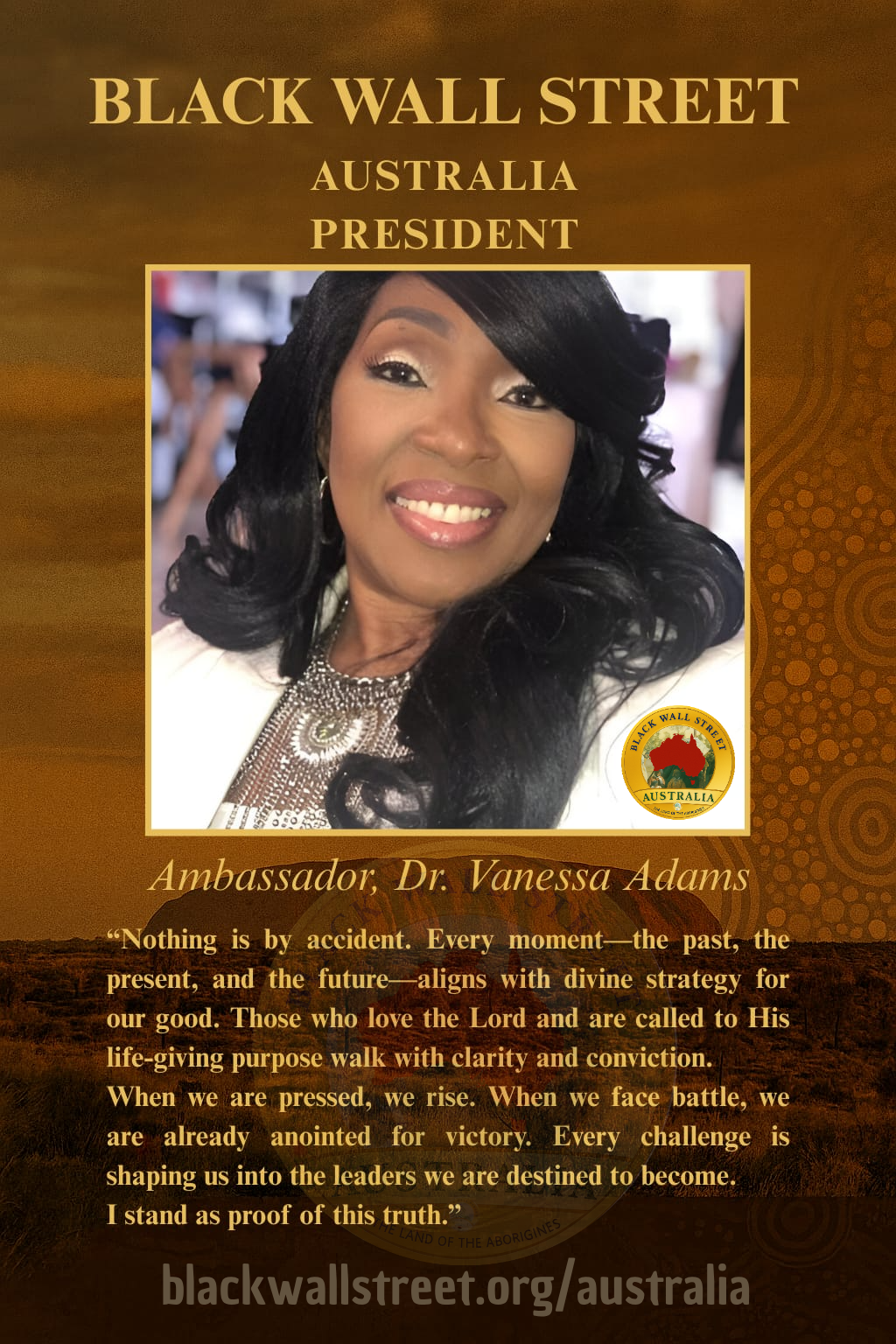
"Nothing is by accident. Every moment—the past, the present, and the future—aligns with divine strategy for our good. Those who love the Lord and are called to His life-giving purpose walk with clarity and conviction. When we are pressed, we rise. When we face battle, we are already anointed for victory. Every challenge is shaping us into the leaders we are destined to become. I stand as proof of this truth." said, Ambassador, Dr. Vanessa Adams who serves as president of Black Wall Street Australia.
The addition of Black Wall Street Australia is more than an organizational milestone—it is a profound re-mapping of global justice movements. It honors the memories of Faith Bandler, Eddie Mabo, and Vincent Lingiari, even as it builds bridges with Martin Luther King Jr., Nelson Mandela, and countless unnamed freedom fighters.
"The Australian Legacy Project is a humanitarian developmental project that will significantly recreate Aboriginal communities of the future. Black Wall Street and the aboriginal leaders of Australia will come together utilizing the history of Tulsa Oklahoma and the African Americans to the Indigenous Aboriginals of Australia. They will be joined together through commerce, economic development, and environmentally conscious businesses; partnering to bring their business concepts, Ideas, restaurants, and medicines to the global market. This will be done with a partnership with Black Wall Street Global Businesses.", said Marshon Kincy, Dr. Carter's Deputy Chief of Staff.
It tells a new generation of Aboriginal and African diasporic youth that they are not isolated. Their struggles are not marginal. They are part of a vast, interconnected fight for the soul of humanity.
And in this Sunday dawn, as the sun rises over both Sydney Harbour and Tulsa’s Greenwood District, the world is reminded: from little things, big things grow.
The establishment of Authentic Hip-Hop Cultural Dance Centers throughout indigenous Australian territories represents a transformative sociocultural project designed to preserve and amplify indigenous artistic expression while situating it within the global athletic sphere. Through formal partnerships with Black Wall Street and the Diaspora Commonwealth, these centers will institutionalize breakdancing—recognized as an Olympic sport—as both a medium of physical training and a vehicle of cultural sovereignty. They will provide indigenous youth with pathways to international recognition, athletic opportunity, and competitive legitimacy, while simultaneously rooting those pathways in indigenous epistemologies and artistic traditions.
Beyond athletic development, the centers will operate as incubators of resilience, confidence, and intergenerational continuity, creating spaces where indigenous identity converges with global hip-hop culture to produce hybrid forms of empowerment. Moreover, this initiative reframes dance not as mere performance but as a critical form of cultural diplomacy, a discipline that conveys indigenous histories, struggles, and aspirations to global audiences. By institutionalizing dance as both sport and narrative, these centers become not only Olympic training grounds but also academies of cultural preservation, where each step performed on a global stage reverberates as an assertion of indigenous dignity and visibility.
The Indigenous Restaurant Franchise Partnership initiative aspires to transform indigenous Australian foodways into a globally recognized cultural and economic enterprise. Through collaborative partnerships between indigenous chefs, tribal cooks, and the strategic infrastructure of Black Wall Street, local recipes will be elevated from family traditions to franchisable models capable of competing in international markets. These restaurants will serve dual functions: they will act as repositories of cultural heritage, safeguarding recipes that might otherwise be lost, and as vehicles for economic transformation, generating employment, tourism, and wealth for indigenous communities.
By integrating indigenous gastronomy into global food economies, the initiative performs cultural diplomacy, projecting indigenous identities into culinary landscapes across continents. The expansion of franchises abroad will not dilute indigenous identity but rather broadcast it, turning each dining experience into an encounter with indigenous history and tradition. Moreover, the franchising process itself will train indigenous Australians in entrepreneurship, supply-chain management, marketing, and global commerce, creating a new class of culturally rooted business leaders. Ultimately, this initiative reframes food as both sustenance and narrative: every dish becomes a story, every restaurant a cultural institution, and every franchise a bridge linking indigenous Australian heritage with the global community.
The creation of Black Wall Street Business Sister-City Districts envisions a transnational network of cultural-economic enclaves that integrate tourism, art, music, and commerce into vibrant ecosystems of Black and Indigenous exchange. These districts will operate simultaneously as tourist attractions and residential spaces, offering immersive experiences in blues, soul, and hip-hop music alongside soul food, comedy, and technological innovation. By fostering this convergence, the initiative constructs cosmopolitan centers of cultural vitality that both honor historical traditions and push toward future-oriented innovation. Each district becomes a site of diasporic solidarity, enabling Black and Indigenous communities to co-create spaces of cultural memory and economic sustainability.
The sister-city framework ensures that these districts are not isolated projects but interconnected nodes in a global network, drawing visitors from across the world while generating lasting economic benefits locally. Beyond their economic function, these districts will challenge narratives of marginality by showcasing Black and Indigenous cultures as central to the modern global experience. They will serve as proof that cultural production, when tied to community ownership and diasporic solidarity, is capable of generating not only financial returns but also deep shifts in how global audiences perceive and engage with marginalized traditions.
The Indigenous Kingdom Collaborative Cities initiative represents a visionary reimagining of urban development, sovereignty, and economic autonomy. With the support of Black Wall Street, the Diaspora Commonwealth, and the Diaspora Buffalo Soldiers, indigenous Australians will reclaim 200 million acres of territory to establish technologically advanced smart cities grounded in indigenous values and governance. Unlike conventional urban projects, these cities will be conceived from the soil upward, embedding indigenous cosmologies, ecological stewardship, and communal principles into the very infrastructure of development.
Each city will function as an indigenous kingdom, with its own governance structures, cultural institutions, and economic frameworks designed to resist external exploitation while fostering internal sustainability. The creation of these cities represents a profound geopolitical shift, positioning indigenous nations not as peripheral communities but as global innovators in sustainable urbanism and cultural sovereignty. They will simultaneously function as laboratories of indigenous governance, educational hubs for STEM and cultural studies, and economic centers capable of competing in international markets. Beyond their material function, these collaborative cities will serve as symbols of reclamation and self-determination, demonstrating that indigenous sovereignty is not merely a legal abstraction but a lived reality made visible through architecture, economy, and community governance.
The Black Wall Street Business Pen-Pal program proposes a novel model of transnational mentorship, knowledge transfer, and entrepreneurial solidarity. By pairing indigenous Australian entrepreneurs with established Black Wall Street business leaders, the initiative aims to create a dynamic exchange of skills, strategies, and resources that will strengthen Indigenous economic resilience. This dialogical partnership goes beyond technical training; it creates a space of cultural reciprocity where shared histories of marginalization and resistance become the foundation for collaborative growth. Through structured mentorship, indigenous entrepreneurs will gain access to expertise in finance, marketing, business planning, and international trade, while their Black Wall Street counterparts will deepen their understanding of indigenous contexts, traditions, and markets. This reciprocity ensures that the program is not extractive but cooperative, reinforcing mutual empowerment across diasporic boundaries.
The pen-pal system, by formalizing these relationships, institutionalizes solidarity and creates long-term structures of support that extend beyond episodic aid. As indigenous entrepreneurs integrate global business strategies into local practices, they will develop enterprises that are simultaneously competitive and culturally grounded. Ultimately, the initiative exemplifies a diasporic model of cooperative economics, wherein mentorship is not merely instructional but transformative, forging enduring bonds between communities separated by geography yet united by history and vision.
The Erroll “Doc” Holliday Sr. Telescope initiative is poised to create the largest telescope multi-view district on Earth, positioning indigenous Australian territories as the epicenter of global astrophysical exploration. Spearheaded by Erroll “Doc” Holliday Sr., the lead engineer of NASA’s Hubble Telescope, the project transcends its scientific mandate by also functioning as a reclamation of indigenous participation in global knowledge production. The telescope city will serve as a dual institution: on one hand, it will be a cutting-edge hub for scientific research, attracting astrophysicists, cosmologists, and students from across the world; on the other, it will be an educational monument that embeds indigenous narratives into humanity’s exploration of the cosmos.
This dual function ensures that indigenous epistemologies—long attuned to the stars through ancestral knowledge systems—are not excluded but rather integrated into the most advanced forms of astronomical inquiry. The facility will generate global tourism, stimulate STEM education, and produce high-paying scientific careers for indigenous youth, thereby weaving together scientific modernity and cultural continuity. By hosting the world’s premier telescope infrastructure on indigenous land, this initiative redefines astronomy not as an elite Western pursuit but as a discipline enriched by indigenous presence, memory, and sovereignty.
The Erroll “Doc” Holliday Sr. Aerospace Theme Park will constitute a groundbreaking fusion of STEM education, aerospace innovation, entertainment, and indigenous cultural history. Developed in partnership with Black Wall Street, STEM leaders, and global theme park architects, the park will serve as a tourist attraction of global significance while simultaneously embedding educational value into every experience. Visitors will engage with interactive exhibits on space exploration, robotics, and engineering, while indigenous Australians maintain ownership and control of the facility, ensuring that the economic dividends of tourism are reinvested locally.
The theme park will not only demystify aerospace for the general public but also serve as a training ground for indigenous youth aspiring to careers in science and engineering, offering a pipeline from entertainment into education and eventually into professional practice. Importantly, the park will integrate indigenous cultural history into its design, demonstrating that indigenous cosmologies and narratives of the stars are as vital as modern aerospace science. This fusion creates a holistic learning environment where past, present, and future intersect, and where indigenous Australians reclaim their place as narrators of the human journey to the cosmos. As both a global tourist destination and a local educational hub, the park represents a revolutionary model in which economic empowerment, cultural preservation, and STEM advancement converge.
The Diaspora Commonwealth Aerospace STEM Indigenous Facility (DCASI Facility) will function as a flagship hub for aerospace research, production, and manufacturing, designed to place indigenous Australians at the forefront of the global aerospace economy. Developed in partnership with Black Silicon Valley, Black Wall Street, Erroll “Doc” Holliday Sr., and retired NASA engineers, the facility will anchor indigenous-led technological innovation in a sector that is central to twenty-first-century global power. The DCASI Facility will operate as both an industrial complex and an educational center, training a new generation of indigenous engineers, scientists, and entrepreneurs in aerospace design, manufacturing, and research.
By embedding advanced manufacturing within indigenous territories, the initiative secures local employment, cultivates high-tech industries, and resists the patterns of dependency that have historically excluded indigenous peoples from cutting-edge economies. Moreover, the facility will serve as a site of international collaboration, attracting partners, investments, and talent from across the world while ensuring that indigenous stakeholders retain primary ownership and control. The DCASI Facility exemplifies how indigenous sovereignty can be articulated not only in cultural or legal terms but also in industrial and technological ones, demonstrating that indigenous communities are capable of both preserving tradition and leading humanity into new frontiers of exploration and innovation.
The Indigenous Diaspora Commonwealth Semiconductor initiative seeks to establish a sovereign semiconductor production facility to serve indigenous Australian, African, and diasporan technology companies. In an era where semiconductors underpin virtually every aspect of modern life—from smartphones and medical devices to artificial intelligence and aerospace systems—control over their production equates to control over the future itself. By creating an indigenous-led semiconductor industry, this initiative ensures that indigenous Australians are not mere consumers of technological products but central producers of their most essential components.
The facility will foster high-level STEM employment, attract global investment, and create a durable foundation for indigenous participation in the global digital economy. It will also catalyze transcontinental partnerships with African and diasporan technology firms, constructing a technological alliance that resists dependency on existing Western or Asian supply chains. Importantly, the semiconductor initiative represents not only an economic strategy but also a political one: by owning the infrastructure of the digital age, indigenous peoples reclaim agency in shaping the technological future. This project reframes indigenous identity as not merely rooted in history but fully engaged in the most advanced architectures of global innovation, ensuring that indigenous Australians stand at the center of the digital revolution rather than its margins.