The Oaklawn Cemetary was life-changing in 1989.
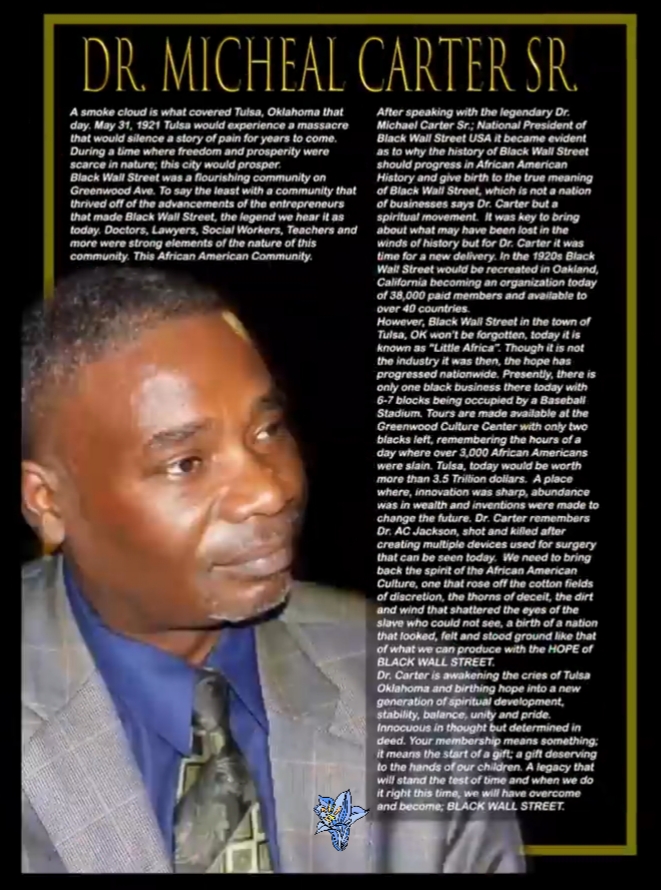
Dr, Micahel Carter, Sr., Th.D., is the globally recognized leader of the Black Wall Street Movement. A son of the Lone Star State, he was rescued from the doorstep of the late Mary Carter in Houston, just two weeks after his birth in 1970. After Mary Carter's transition in 1978, he was lovingly taken in by Mother Viola Wright. Throughout his life, Dr. Carter never met his biological mother or father, yet he found purpose and identity through faith and service.
Since he was fourteen years old, Dr. Carter has devoted his life to preaching the Gospel. His ministerial journey has taken him to over 60 countries, sharing his message of faith and hope with countless people around the world.
Dr. Carter is an alumnus of Arkansas Baptist College and received his theological training under the mentorship of Dr. Anthony E. Darrington, Sr. at Piedmont Theological Seminary in 2009. Inspired by Dr. Larry Moore, founder and president of Moore University of Theology, Dr. Carter pursued and completed his doctoral studies in theology. His dissertation, titled "The Effects of Crucifixion on the Human Body: The Crucifixion of Jesus Christ" (2014), reflects his deep scholarly commitment to understanding the physical and spiritual significance of Christ’s sacrifice.
Dr. Carter Sr., is the founder and national president of Black Wall Street USA, a nonprofit organization established in 1998 with the mission to promote economic development and community edification within the Black community. Inspired by the legacy of Ottawa "O.W." Gurley, who was instrumental in developing Tulsa's Greenwood District into the original "Black Wall Street," Dr. Carter aims to replicate that success by fostering urban areas where 50% to 70% or more of businesses are Black-owned.
Under Dr. Carter's leadership, Black Wall Street USA has initiated several programs to support Black entrepreneurship and economic empowerment. One notable initiative is the Black Wealth Initiative, which leverages real estate entrepreneurship to help Black families achieve economic independence. Dr. Carter emphasizes the importance of focusing on the big picture and leaving the small things small.

The impact of Dr. Carter's work is recognized by other leaders in the community. Kuma Roberts, interim president and CEO of the Black Wall Street Chamber of Commerce, has expressed enthusiasm for invigorating the organization's mission of economic development, stating, "As we move forward, we will foster a culture of robust entrepreneurship. Our commitment to inclusive economic development will not waver." Additionally, efforts are underway to have the Greenwood District designated as a national monument, with Tulsa Mayor G.T. Bynum writing to President Joe Biden that "this monument would highlight a historically-forgotten-about event in American history and serve as a warning that this moment in history must never be repeated." These initiatives underscore the ongoing commitment to honoring the legacy of Black Wall Street and ensuring its history informs future economic development.
Dr. Michael Carter Sr.'s leadership and vision have been instrumental in the recognition and establishment of Black Wall Street Districts in Chicago, Illinois. In 2006, his efforts culminated in House Resolution 1257 by the 96th General Assembly of the Illinois House of Representatives, officially recognizing Stony Island Avenue as a Black Wall Street District. This designation honored the area's rich history of African American entrepreneurship and aimed to promote economic development within the community. Building upon this momentum, on August 29, 2009, the Illinois State Senate passed Resolution SR0432 , acknowledging 75th Street east of the Dan Ryan Expressway as a commercial corridor where 80% or more of the businesses are owned by African Americans. This area serves as a prime example of a Black Wall Street District in Chicago, featuring a variety of flourishing businesses, including family-owned establishments, restaurants, clothing stores, and beauty shops.
Illinois House Bill 1775 HB1775 establishes the Black Wall Street Program, a statewide economic development framework designed to support the creation and growth of designated Black Wall Street Business Districts. The legislation authorizes the Illinois Department of Commerce and Economic Opportunity to provide financial assistance, investment support, and programmatic infrastructure to municipalities that formally adopt and sustain these districts. HB1775 reflects a policy commitment to revitalizing historically Black commercial corridors, expanding access to capital for African American–owned businesses, and institutionalizing Black Wall Street as a modern model for community-anchored economic sovereignty—an area of civic and economic policy closely aligned with Dr. Carter’s work.
Beyond Illinois, legislative efforts to honor and preserve the legacy of Black Wall Street have been initiated at both federal and state levels. In 2024, the U.S. Senate passed the Historic Greenwood District—Black Wall Street National Monument Establishment Act , introduced by Senator James Lankford (R-OK) and Senator Cory Booker (D-NJ). This bill aims to establish the Historic Greenwood District—Black Wall Street National Monument in Oklahoma as a unit of the National Park System, preserving and interpreting the resources associated with the Historic Greenwood District and the 1921 Tulsa Race Massacre. The bill awaits consideration in the House of Representatives. Additionally, various state assemblies have pending legislation focused on reparations and economic development for African American communities, reflecting a broader movement to address historical injustices and promote economic empowerment nationwide.
In recognition of his tireless service, Dr. Carter was awarded the Joe Biden Presidential Volunteer Award in 2021 by Dr. Angela Harris, in honor of our ancestors who were tragically murdered during the Tulsa Massacre in 1921.
Dr. Michael Carter Sr.’s vision transcends the limitations of time, culture, and circumstance. His life’s work stands as a theological and sociological thesis in motion — a divine experiment in faith, economics, and justice. One hundred years from now, the blueprint he has drafted will have matured into living cities of spiritual and economic sovereignty — communities governed by truth, justice, and divine reciprocity. Two hundred years from now, historians and theologians alike will cite the Carter Doctrine of Faithful Reconstruction as the turning point when the children of the diaspora reclaimed not only their history but their destiny. And three hundred years from now, when nations gather to define civilization’s moral center, they will trace its foundation to a people who believed that God’s promise was not bound by geography, but awakened through divine order. For the Holy Qur’an affirms: “Indeed, Allah will not change the condition of a people until they change what is in themselves” القرآن الكريم Surat Ar-Qur’an 13:11, and the Word of God declares, “Write the vision, and make it plain upon tables, that he may run that readeth it, Habakkuk 2:2.
Standing upon the eternal Word of God and illuminated by the Principles of Ma’at—Truth, Justice, Harmony, Balance, Order, and Reciprocity—Dr. Carter’s work emerges as both revelation and renaissance. His leadership calls forth not only the reconstruction of Black Wall Street but the reimagination of human society itself: a civilization in alignment with divine law and moral equilibrium. Within his legacy lies a summons to future scholars, prophets, and builders — to continue the labor of faith until every valley is exalted and every shadow transformed by light. The Trail of Tears becomes the Highway of Healing; the dream deferred becomes the doctrine fulfilled. And from the dust of tragedy rises the architecture of eternity, echoing the unchanging voice of God: “Behold, I make all things new”, Revelation 21:5.


Marshon Kincy
Marshon serves as the principal executive officer supporting the Chief of Staff and stands as the second-ranking authority within the Office of the Chief of Staff. In this capacity, he plays a central role in sustaining organizational discipline, strategic alignment, and leadership continuity in direct support of the President’s overarching vision. The Deputy Chief of Staff ensures that the internal architecture of the organization operates with precision, cohesion, and purpose, reinforcing the executive direction established by the President. As Deputy Chief of Staff, Mr. Kincy oversees the coordination of internal systems that enable seamless alignment across departments, chapters, councils, and executive leadership. He ensures that strategic priorities are translated into executable frameworks, maintaining clarity of direction and unity of effort throughout the organization. His role strengthens cross-functional collaboration, reinforces leadership accountability, and guarantees that all internal functions operating under the Office of the Chief of Staff remain fully aligned with Black Wall Street USA’s national and global objectives for Black economic empowerment.
Serving as both an executor of organizational priorities and a guardian of workflow discipline, Mr. Kincy provides firm leadership over execution, deliverables, and institutional follow-through. He ensures that directives issued from executive leadership are carried forward with consistency, accuracy, and timeliness. Through disciplined oversight, the Deputy Chief of Staff reinforces performance standards, maintains momentum across initiatives, and upholds the organizational structure that allows the Chief of Staff to remain focused on high-level strategy, presidential counsel, and national and international representation. Within the Office of the President, Mr. Kincy is entrusted with leadership continuity and operational command during the absence of the Chief of Staff, and when delegated, acts with full executive authority to preserve stability and forward progress. He coordinates rapid responses to emerging internal or external developments, ensures uninterrupted execution of presidential directives, and maintains the organization’s strategic posture during periods of transition or urgency. As a central point of executive coordination, the Deputy Chief of Staff translates presidential and chief-of-staff direction into structured plans that are executed effectively across leadership bodies.

Ethel Cain Russell
Ethel serves as the unifying force behind the organization’s nationwide network of chapters, councils, and directors. As a senior leader within the Office of the President, Ms. Russell ensures that the President’s vision and strategic priorities are effectively carried out across every state where Black Wall Street USA operates. Her leadership transforms national directives into actionable state-level initiatives—bridging the gap between policy and practice, strategy and community impact. Ms. Russell functions as the central coordinator and operational leader for all state councils, ensuring that each operates with clarity, accountability, and alignment to the national mission. She brings together the efforts of hundreds of members, directors, and volunteers across the country, transforming individual state movements into a unified national force for Black economic empowerment.
Through her disciplined oversight and steady communication, she guarantees that every state chapter contributes meaningfully to the larger goal of rebuilding and sustaining economic independence within Black communities. As Deputy Chief of Staff of U.S. States, Ms. Russell manages the vital flow of communication between the Office of the President, and each State Director. Her work ensures consistency in message, clarity in priorities, and precision in execution. She leads national coordination calls, develops accountability frameworks, and provides direct support and mentorship to state leaders. Under her leadership, state councils are empowered to organize effective membership drives, business development programs, community engagement initiatives, and advocacy campaigns—all reflecting the President’s national agenda for economic growth and justice.

Elder Earnest Gardner
The Policy Advisor of Black Wall Street USA serves as a senior strategist and principal architect of the organization’s policy and advocacy agenda. In this vital role, Ernest Gardner, Policy Analyst, operates within the Office of the President to transform vision into structured legislative priorities and public policy frameworks that advance economic empowerment, reparations, land acquisition, institutional development, and systemic equity for Black communities across the nation and throughout the global African diaspora. This position is not governed by politics alone, but by principle. The office is anchored in spiritual foundations — guided by God’s judgments, statutes, and divine order as the moral framework for economic freedom and social liberation. Black Wall Street USA affirms that true freedom must be rooted in righteousness, justice, stewardship, and covenant responsibility. Ernest Gardner’s policy leadership is therefore shaped by ethical integrity, spiritual discernment, and accountability to higher law. Policy is approached not merely as a mechanism of influence, but as an instrument for restoring families, strengthening institutions, and building economies aligned with divine standards.
As senior policy strategist, Ernest Gardner provides direct counsel to the President, shaping the organization’s official positions on legislation, regulatory reforms, executive actions, and civic initiatives affecting Black economic and social advancement. He ensures alignment between national advocacy efforts and the long-term vision of rebuilding self-sustaining Black economies rooted in ownership, production, banking, education, health sovereignty, and global trade. Through disciplined research and strategic analysis, he develops policy solutions designed not for temporary relief, but for generational transformation. Ernest Gardner leads the development of comprehensive policy proposals addressing reparative justice, access to capital, cooperative enterprise law, minority banking reform, agricultural revitalization, housing equity, infrastructure investment, and educational reform. Each initiative is evaluated through three guiding lenses: spiritual alignment, economic viability, and generational impact. This integrated approach ensures that Black Wall Street USA advances structural change grounded in faith, strategy, and measurable outcomes.


Kevin Sapp
Kevin serves as the principal architect of long-range advancement for the organization, stewarding the conception, development, and execution of its most consequential and institution-defining initiatives. His responsibility is to transform the President’s macro-level vision into measurable, durable realities—initiatives that empower Black communities, strengthen global networks, and establish resilient economic ecosystems. Whether designing national economic infrastructures, advancing business incubator systems, forging international alliances, or leading the development of technology platforms for Black-owned enterprises, Mr. Sapp directs initiatives that expand and redefine the strategic horizons of Black Wall Street USA. Central to this role is the oversight, integration, and strategic coherence of more than 330 active initiatives within the Black Wall Street Global Initiatives Portfolio, ensuring alignment, accountability, and continuity across all efforts.
Within the Office of the President, Mr. Sapp functions as an executive driver of transformational change, ensuring that every major undertaking reflects the long-term mandate for economic sovereignty, generational wealth-building, and global Black empowerment. He provides intellectual and strategic leadership by translating complex visionary concepts into executable frameworks, structured implementation pathways, and rigorous evaluation models with defined milestones and impact metrics. In close collaboration with the President, Mr. Sapp ensures that initiatives are properly prioritized, sequenced, and resourced in alignment with institutional objectives. This coordination guarantees that the organization’s most ambitious strategies are carried forward with precision, discipline, and strategic foresight. Mr. Sapp’s work extends beyond initiative leadership into the broader evolution of the organization itself. He oversees experimental pilots, cross-sector collaborations, and research-driven development models designed to pioneer new paradigms of Black economic advancement. Through continuous environmental scanning, policy analysis, and technological forecasting, Mr. Sapp identifies emerging opportunities capable of strengthening Black entrepreneurship, expanding global reach, and enhancing strategic intelligence. By convening multidisciplinary working groups and mobilizing national and international partners, he helps ensure that Black Wall Street USA remains at the forefront of economic empowerment methodologies and global movement-building.