Moore now returns to the voters in 2026 seeking another term. His candidacy carries a significance beyond the Maryland ballot because he is no longer standing at the end of a very short historical list. He is standing at the beginning of what could become a much longer one. His reelection campaign also provides an important test for the broader evolution of Black gubernatorial politics. A historic first must eventually become an evaluated record. Voters are asked not merely to celebrate the breakthrough but to decide whether the person who broke the barrier deserves to remain in the position.
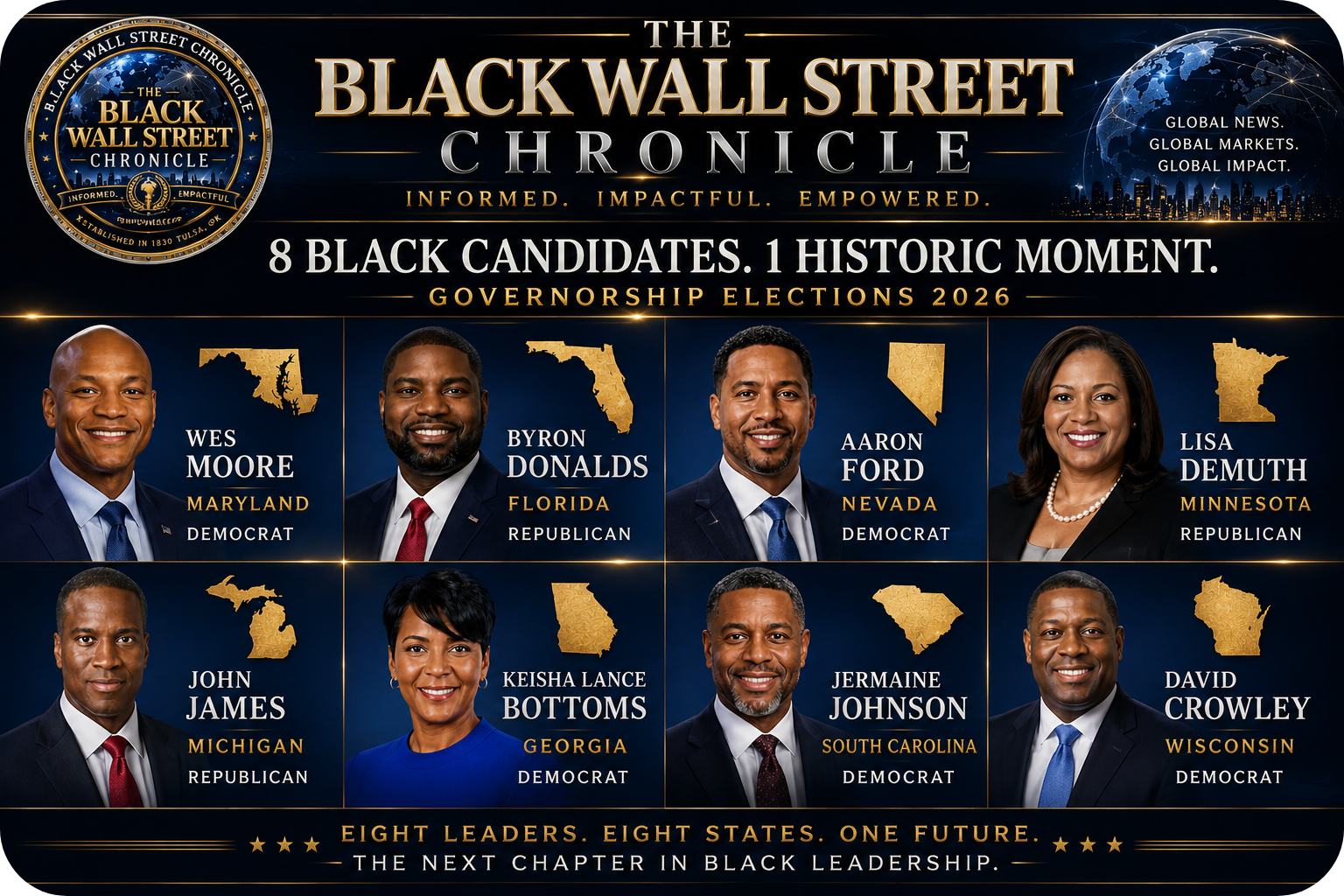
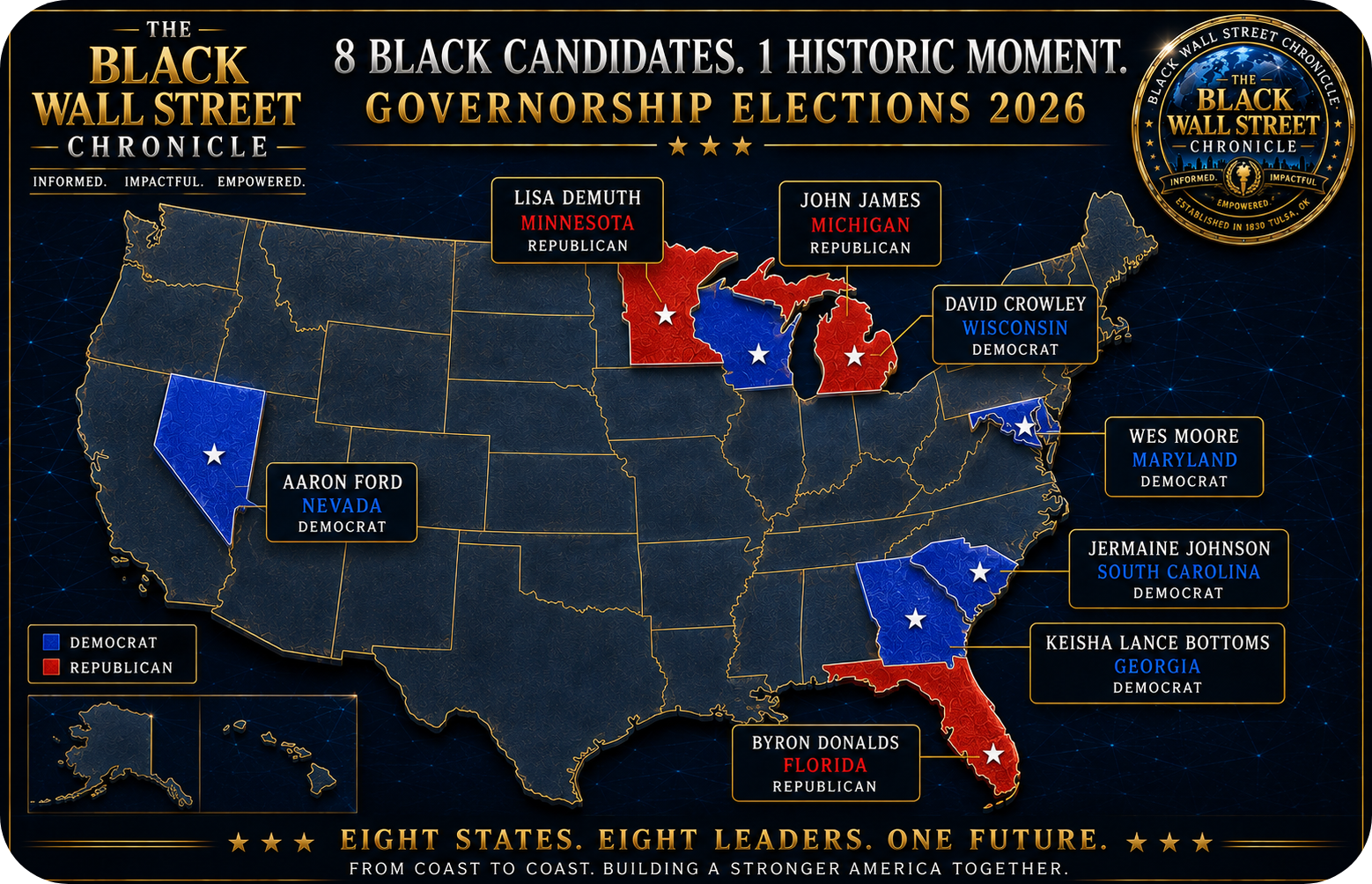
Florida offers perhaps the most politically striking example of that expansion because Republican Byron Donalds is now the party's nominee for governor. Donalds is seeking to become Florida's first Black governor, and his candidacy demonstrates that the 2026 moment is not confined to Democratic politics. He is a conservative Republican, a member of Congress and a former Florida state legislator who has built a national political profile while maintaining a strong connection to his state.
Donalds' candidacy matters because it challenges a simplistic understanding of Black political representation. Black Americans have often been discussed in national politics as though they form one political constituency with one political philosophy. The reality is far more complicated. Black communities contain conservatives, moderates, progressives, independents and people whose political priorities cannot be comfortably placed within any traditional ideological category. The emergence of Black Republican gubernatorial nominees in 2026 makes that diversity visible at one of the highest levels of state politics.
If Donalds wins, Florida would have its first Black governor. But even before Election Day, his nomination has already changed the historical picture. A Black Republican is now competing for the executive leadership of one of the nation's largest and most politically influential states. His campaign forces observers to look beyond the familiar assumptions that have shaped discussions of Black political leadership for decades. It also demonstrates that the pursuit of executive power is increasingly taking place across ideological lines.
Nevada's Aaron Ford brings a different kind of political experience to the field. Ford is Nevada's attorney general and previously served as majority leader of the Nevada Senate. He became the state's first Black attorney general when he took office in 2019. His career has placed him inside both legislative and executive government, giving him a perspective that comes from having participated in the process of making laws and then serving in an office responsible for enforcing them.
Ford's candidacy also illustrates the tension that Black candidates frequently navigate. Representation matters, but voters ultimately expect results. A candidate can acknowledge the historical importance of being Black without making racial identity the entire campaign. Ford has emphasized issues that affect Nevada broadly, including jobs, housing, healthcare, civil rights and voting rights. That approach reflects an important evolution in Black statewide politics: the candidate is asking voters to recognize the historic significance of the campaign while simultaneously demonstrating an ability to govern for an entire state.
Minnesota's Lisa Demuth represents another dimension of the 2026 moment. Demuth is the Republican nominee and has already made history as the first Black speaker of the Minnesota House. Her gubernatorial campaign carries the possibility of another breakthrough because Minnesota has never elected a Black governor and has never elected a woman governor. If Demuth wins, two barriers would fall simultaneously.
Her candidacy also demonstrates the changing relationship between identity and political leadership. Demuth has indicated that she has not made identity politics the centerpiece of her career, while also recognizing the historic significance of the position she is seeking. There is something revealing in that balance. Earlier generations of Black candidates often had to make representation itself the central argument because the mere presence of a Black candidate was an extraordinary political statement. Today's candidates increasingly have the opportunity to say something different: that their race is part of their story, but their ability to lead is the reason voters should entrust them with power.
The significance of Demuth's candidacy also extends to the question of how American voters perceive Black women in executive leadership. For decades, Black women have played essential roles as organizers, educators, community leaders, elected legislators and political strategists. Yet the number who have occupied the nation's highest executive offices has remained extremely small. A successful Demuth campaign would therefore challenge several assumptions simultaneously and add another dimension to the growing diversity of Black political leadership.
John James carries another Republican candidacy into the 2026 field. A businessman, military veteran and member of Congress, James has previously competed in statewide Michigan politics and developed a national profile. His nomination now gives Michigan an opportunity to elect its first Black governor.
Michigan's political history gives that possibility particular weight. The state has been central to America's industrial development, labor movement, automobile industry and Black migration. Detroit became one of the most important centers of Black economic, cultural and political life in the nation. Yet that historic Black presence has never produced a Black governor. James's candidacy therefore places the question of Black executive leadership into a state where Black political influence has long been substantial but has not yet reached the governor's mansion.
In Georgia, the historical implications become even more profound. Keisha Lance Bottoms, the former mayor of Atlanta, is the Democratic nominee for governor. If she wins, she will become the first Black woman elected governor in American history. She would also become Georgia's first woman governor.
The significance of that possibility extends far beyond a demographic milestone. Atlanta has long stood at the center of Black political and economic life in the United States. The city became a national symbol of Black political leadership, business development, education and civic organization. Its mayors and institutions have influenced national politics for generations. Bottoms' experience leading Atlanta gives her a background in executive government that is particularly relevant to a gubernatorial campaign. She has already governed a major American city and dealt with the complicated intersection of public safety, housing, infrastructure, economic development and community expectations.
A Bottoms victory would therefore represent several historical transitions at once: from city hall to the governor's mansion, from Black male gubernatorial history to Black female gubernatorial history, and from Atlanta's extraordinary tradition of Black municipal leadership to statewide executive authority. It would also carry a symbolic message to Black women across the country who have spent generations doing much of the organizing and institution-building that sustains political movements while remaining underrepresented in the highest levels of executive government.
South Carolina's Jermaine Johnson adds another important Southern dimension to the field. His candidacy places Black executive representation into a state with a deeply consequential African American electorate and a history that reaches directly into the earliest chapters of American slavery, Reconstruction and civil rights. South Carolina has been home to generations of Black political organizing, yet its highest elected office has remained beyond the reach of a Black candidate.
That contradiction is part of the larger national story. Black Americans have played an enormous role in determining elections, particularly in Southern states, while often remaining underrepresented in the highest executive offices. The 2026 gubernatorial field raises the question of whether that relationship is beginning to change. Electoral influence and governing authority are not the same thing, and the path from being a decisive voting bloc to controlling executive institutions has historically been a difficult one.
David Crowley's candidacy in Wisconsin provides yet another example. Crowley, the Milwaukee County executive, became the first Black person to win a major-party nomination for Wisconsin governor. His background is particularly significant because executive experience at the county level provides a practical education in government. County executives do not merely make speeches; they manage budgets, oversee departments, address public safety, work with municipalities and negotiate with other levels of government.
Crowley's nomination therefore represents both a historic first for Wisconsin and a continuation of a broader movement toward Black candidates seeking executive offices with substantial governing responsibility. His path also reflects a growing recognition that leadership experience can be developed outside the traditional routes to statewide office. The mayor's office, county executive office, attorney general's office and legislative leadership can all serve as preparation for the governor's mansion.
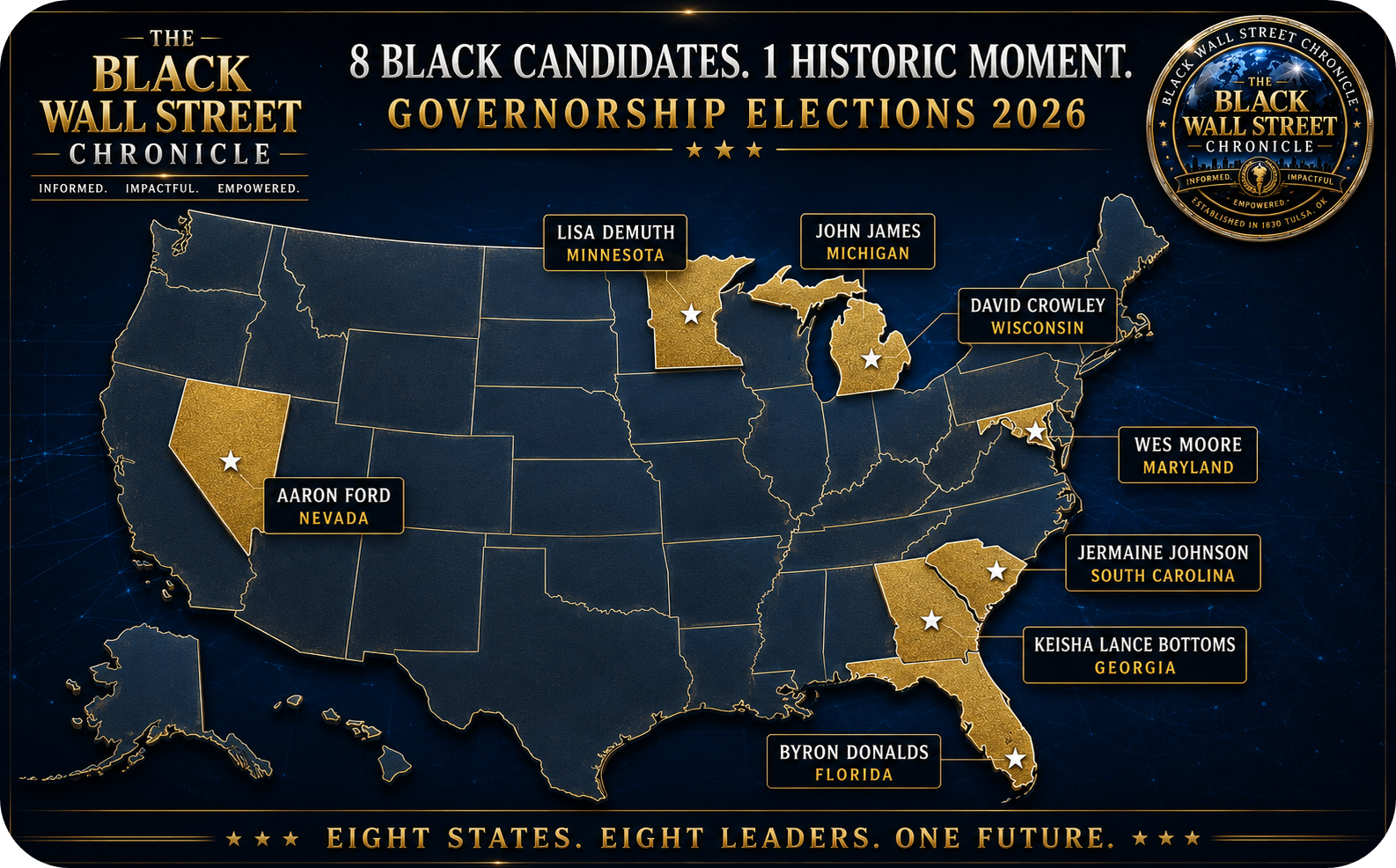
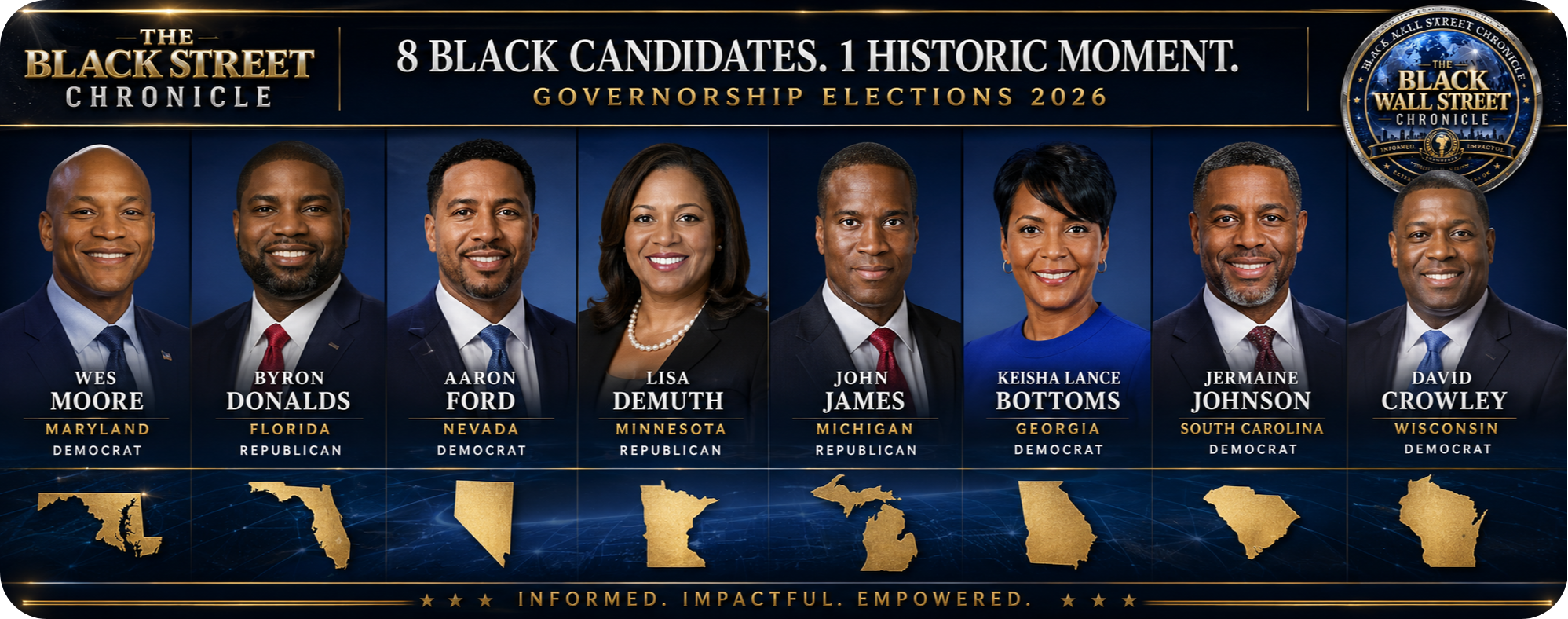
Taken together, these eight campaigns represent something that has never happened before in an American gubernatorial election cycle. The field crosses party lines, regional boundaries and political philosophies. It includes an incumbent governor, former mayors, attorneys general, legislators, members of Congress and county executives. Their backgrounds are different, but the historical question before them is similar: can the governorship, an office that has been so difficult for Black Americans to reach, finally become an arena where Black candidates compete in significant numbers?
The importance of the two-party nature of this field should not be overlooked. Political representation becomes more durable when it is not dependent upon a single party or ideological coalition. The presence of Black gubernatorial nominees within both parties means that Black executive leadership is becoming part of a broader American political conversation rather than remaining confined to one partisan tradition. It also gives voters an opportunity to evaluate Black candidates according to competing visions of government, economics, public policy and leadership.
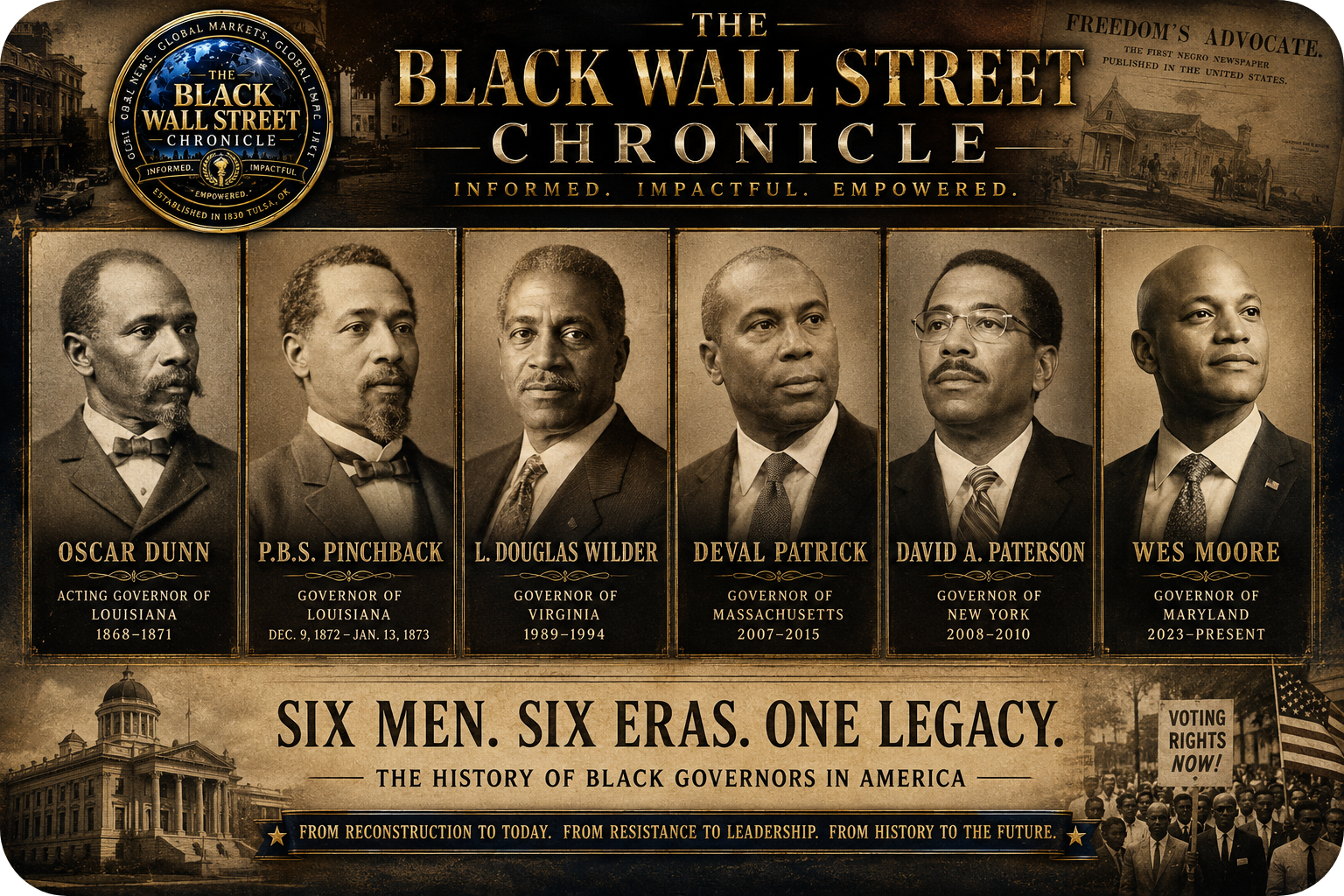
To understand how extraordinary that question is, it is necessary to go back to the beginning.
The story begins during Reconstruction with Oscar Dunn in Louisiana.
Dunn emerged at a time when the nation was attempting to rebuild itself after the Civil War and redefine the meaning of citizenship following the abolition of slavery. Black men in the South were voting and holding public office in numbers that would have been unimaginable only a few years earlier. Reconstruction governments created opportunities for Black political participation, and Louisiana became one of the most important centers of that political transformation.
In 1868, Dunn was elected lieutenant governor of Louisiana, becoming the first elected Black lieutenant governor of an American state. After the death of Governor Henry Clay Warmoth's lieutenant governor, Dunn exercised the powers of governor in an acting capacity. His political career demonstrated that emancipation was not merely a legal change. For a brief period, it was producing a new political order in which formerly enslaved people and their descendants could participate in governing the states in which they lived.
But Reconstruction was fragile, and Dunn's political world was surrounded by violence and political conflict. He died in 1871. The promise represented by his rise would soon become increasingly difficult to sustain. The political forces opposing Reconstruction understood that control of the ballot box was inseparable from control of government, and the struggle over Black voting and officeholding would become one of the defining conflicts of the post-Civil War South.
P.B.S. Pinchback followed him into Louisiana politics and became the first Black person to serve as governor of a U.S. state. Pinchback was born in 1837 and became active in Republican politics during Reconstruction. He served as a state senator and eventually became lieutenant governor. When Governor Warmoth was suspended during an impeachment crisis in December 1872, Pinchback assumed the governorship.
His tenure was brief, lasting only a little more than a month. Yet the length of his administration does not diminish its significance. For that short period, a Black man occupied the highest executive office of an American state. The achievement was especially remarkable because it occurred only a few years after the end of slavery, when the political system was still being reconstructed and the meaning of Black citizenship was being contested throughout the South.
Pinchback's experience also revealed the dangers surrounding Black political power during Reconstruction. Louisiana was engulfed in disputes over elections, competing political factions and racial violence. The Reconstruction political order was collapsing, and the forces seeking to restore white political control were becoming increasingly aggressive.
Pinchback would continue to pursue political influence after leaving the governor's office, including an unsuccessful effort to take a seat in Congress. But the larger political system was changing around him. Reconstruction eventually ended, federal protection receded and white supremacist governments reestablished control across the South.
The political door that Dunn and Pinchback had entered slammed shut.
For more than a century, no Black American would be elected governor of a state.
That silence is essential to understanding the importance of L. Douglas Wilder.
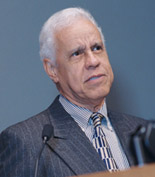
In 1989, Virginia voters elected Wilder governor. More than a century after Pinchback's brief tenure in Louisiana, a Black American had once again reached a state governor's mansion. But this time there was a crucial difference. Wilder had not inherited the office. He had won it.
That distinction made Wilder's election one of the most important political breakthroughs of the twentieth century. Virginia was the former capital of the Confederacy and one of the states most deeply associated with slavery and segregation. Yet its voters elected a Black man to lead the state.
Wilder had already broken barriers before becoming governor. He had served in the Virginia Senate and became the state's first Black lieutenant governor. A Korean War veteran and lawyer, he brought years of political experience to the governorship. His victory demonstrated that Black political leadership could not only exist in the aftermath of Reconstruction but could return through the electoral process itself.
Yet the fact that another seventeen years passed before the next Black American was elected governor tells us how difficult that breakthrough remained.
In 2006, Massachusetts voters elected Deval Patrick.
Patrick's story carried the American promise of upward mobility. Born on Chicago's South Side, he rose from a working-class background to Harvard College and Harvard Law School and eventually served as assistant attorney general for civil rights in the Clinton administration. His election made him the second Black American elected governor of a state.
Patrick's victory was important because it demonstrated that Black gubernatorial leadership was not geographically limited to the South. Massachusetts, a state with its own complicated history concerning race, immigration, abolition and American political development, had elected a Black governor.
Patrick served two terms, governing from 2007 through 2015. His experience also contributed to a continuing lesson about Black candidates for statewide office: historic identity may be part of the significance of a campaign, but successful candidates must ultimately present themselves as leaders capable of representing the entire electorate.
Then came David A. Paterson.
Paterson's path to the governorship was fundamentally different. In 2008, New York Governor Eliot Spitzer resigned, and Paterson, then serving as lieutenant governor, succeeded him. Paterson therefore became New York's first Black governor, but he was not elected directly to the governor's office.
His story is important because it reminds us that the history of Black governors contains different forms of achievement. Some reached the office through election. Others reached it through constitutional succession. Both forms of service matter, but they should not be confused when counting elected governors.
Paterson also made history beyond race. He was the nation's first legally blind governor. His career in New York politics had already included years of service in the State Senate and leadership within the Democratic caucus.
His arrival in Albany continued a gradual transformation of American executive government. Black politicians were increasingly moving from legislative roles into positions where they were responsible for administering entire governments.
Then, in 2022, Maryland voters elected Wes Moore.
The significance of Moore's victory was immediately understood. He became the third Black American elected governor in American history. More than three decades had passed since Wilder's election, sixteen years since Patrick's, and generations had passed since the Reconstruction-era governors of Louisiana.
Moore's election did something else: it created a bridge between the history of Black governors and the generation now competing in 2026. His inauguration provided a visual reminder that American history does not disappear when a new generation enters public office. It travels with them, often in ways that become apparent only when the present is viewed alongside the past.
When Moore won, the list of Black Americans elected governor still contained only three names.
Now eight Black major-party nominees are preparing for the general election.
That is why 2026 deserves to be remembered.
The significance does not depend on how many of the eight ultimately win. Elections will determine that. Some will become governors, and some will return to public life without the title they sought. But the field itself has already established a new historical benchmark.
For nearly a quarter of a millennium, Americans elected only three Black governors.
In one election cycle, eight Black major-party nominees are competing.
The shift is not simply numerical. It reflects a broader change in the nature of Black political leadership.
The early Black governors emerged during Reconstruction, when the fundamental question was whether formerly enslaved Americans could exercise citizenship and political authority at all. Wilder's generation confronted a different question: could the political barriers erected after Reconstruction finally be broken? Patrick and Paterson demonstrated that Black executive leadership could expand beyond Virginia and into the nation's largest states and regions. Moore represents a new generation that has grown up with the expectation that the governorship, while difficult, is not beyond reach.
The eight candidates of 2026 represent what may be the next stage.
The question is no longer simply whether a Black American can become governor.
That question was answered decades ago.
The question is whether Black governors can become a normal part of American political life.
That is a much bigger question.
Normalcy is ultimately the goal of every historic breakthrough. A first is important because it proves something can be done. But the true measure of progress is what happens after the first. Does the door remain open? Do more people enter? Does the institution change? Does the society begin to view the presence that was once extraordinary as ordinary?
The eight candidates of 2026 suggest that the door is opening wider.
Their political differences are not a weakness in the story. They are part of the story.
A Black Republican running in Florida, Black Republicans competing in Minnesota and Michigan, and Black Democrats running in Maryland, Nevada, Georgia, South Carolina and Wisconsin demonstrate that Black political participation cannot be reduced to a single ideology.
That diversity is important for another reason. It moves the conversation away from the idea that Black political advancement is merely about obtaining symbolic representation and toward the harder question of governing philosophy. What will these candidates do with executive power? How will they approach education, economic development, public safety, housing, healthcare, infrastructure and opportunity? What will they do to ensure that communities that have historically been left outside the centers of economic growth are included in the next generation of development?
Those questions matter to the future of Black America.
They also matter to the future of America itself.
The Black Wall Street tradition has always understood that political and economic power are intertwined. The original Black Wall Street in Tulsa became famous because Black residents built businesses, professional institutions, financial enterprises, newspapers and community organizations in a society that attempted to limit their opportunities. The broader tradition of Black economic development has always rested on the idea that communities must build capacity—not simply wait for inclusion.
Political representation is part of that capacity.
A governor cannot create generational wealth with a signature.
But a governor can influence the economic environment in which generational wealth is created.
A governor can influence infrastructure decisions, workforce investments, educational systems, procurement policies, transportation networks, housing policy and economic development priorities. The governor's office can determine which communities receive attention and which communities remain on the margins.
That is why executive leadership matters.
There is also a generational dimension to this moment. The significance of seeing a Black governor is different for someone who lived through segregation than it is for someone who has grown up in the twenty-first century. For an older generation, Wilder's election could represent the breaking of a barrier that once seemed nearly permanent. For a younger generation, Moore's presence in Maryland may establish an expectation that someone who looks like them can aspire to executive leadership. The psychological impact of that change should not be underestimated. Political possibility is itself a form of civic education.
The 2026 field also demonstrates that the story of Black political leadership is increasingly about women as well as men. Black women have long formed the backbone of political organizing, voter registration, civil rights campaigns, churches, schools and community institutions. Yet the governorship has remained particularly resistant to Black female leadership. A Keisha Lance Bottoms victory in Georgia would change that history nationally, while Lisa Demuth's candidacy in Minnesota adds another dimension to the conversation about Black women and executive power.
That makes the 2026 election significant even beyond the final count of governors. It raises the possibility that future generations will encounter a political landscape in which Black men and Black women are competing for executive leadership across the ideological spectrum. The historical question will increasingly be less about whether a Black person belongs in the governor's mansion and more about what kind of leader that person intends to be once there.
The election will also test whether historic candidacies can be translated into governing coalitions. Winning a primary is one achievement; winning a statewide general election is another. A gubernatorial candidate must appeal to voters across cities, suburbs and rural communities, across racial and economic groups and, often, across competing political traditions. The candidates of 2026 are therefore participating in an experiment in coalition-building as much as they are participating in an experiment in representation.
That is perhaps why the eight campaigns should not be reduced to a simple celebration of diversity. Their historical significance is real, but the deeper issue is what happens when representation reaches executive power. The test will ultimately be performance, accountability, economic outcomes, institutional leadership and the ability to translate campaign promises into measurable results. The maturation of Black political leadership means demanding excellence rather than treating representation as sufficient in itself.
The significance of 2026 is therefore larger than the question of how many Black candidates win.
It is about the continuing movement from representation toward institutional power.
Oscar Dunn and P.B.S. Pinchback showed that Black executive leadership was possible during Reconstruction, even though the political order that produced their rise would soon collapse. Douglas Wilder reopened the door through an electoral victory that seemed almost unimaginable in the state that had once served as the capital of the Confederacy. Deval Patrick demonstrated that the breakthrough could be repeated in New England. David Paterson showed that Black executive leadership could emerge through succession in New York. Wes Moore brought a new generation into the story.
Now eight candidates stand at the threshold. Their campaigns belong to 2026, but their history belongs to all of those who came before them. The eight candidates running today did not create the road they are traveling. They inherited it.
Every ballot on which their names appear carries some part of the struggle that preceded them. Every campaign event takes place in a political system transformed by generations of Black voting, organizing, litigation, institution-building and civic engagement. Every Black candidate who can realistically compete for governor stands on ground that previous generations had to fight to establish.
That does not mean the struggle is over. It means the struggle has changed. There was a time when the question was whether Black Americans would be permitted to vote. There was a time when the question was whether Black voters could elect representatives. There was a time when the question was whether a Black candidate could win statewide.
Today, the question is whether Black executive leadership can become a sustained and ordinary feature of American government. That is the deeper story of the eight candidates of 2026. The election will produce winners and losers, but history has already produced a milestone.
Eight Black major-party gubernatorial nominees are competing in one election cycle. The number stands in stark contrast to the six Black Americans who have served as governors throughout American history and the three who have been elected directly by voters. That contrast is what makes this moment so powerful. It reminds us how long the road has been. It reminds us how recently the door opened. And it reminds us that history does not move in a straight line. Sometimes it advances. Sometimes it retreats. Sometimes generations pass before another barrier falls.
But occasionally, a new generation arrives and makes the old limitations look increasingly inadequate. The 2026 gubernatorial field may be one of those moments. The names of Oscar Dunn, P.B.S. Pinchback, Douglas Wilder, Deval Patrick, David Paterson and Wes Moore belong to different eras, different states and different political circumstances. Yet together they form a chain. The eight candidates of 2026 represent the next link.
Whether they win or lose, they have already expanded the boundaries of what a Black candidate for governor looks like in America. They have expanded the geography, the political affiliations, the professional backgrounds and the possibilities. And that may ultimately be the most important achievement of all. Because the goal of history is not to produce endless firsts. The goal is to make the first no longer necessary.
A day may eventually come when Americans will not stop to count how many Black governors are running, because the question will have become as ordinary as counting any other group of candidates. A day may come when a Black woman running for governor in Georgia, a Black Republican running in Florida, a Black Democrat running in Nevada or a Black executive running in Wisconsin is evaluated first and foremost on the merits of the campaign and the capacity to govern.
That day has not completely arrived. But 2026 suggests that America is moving closer. From Reconstruction Louisiana to Virginia, Massachusetts, New York and Maryland, and now across eight states in a single election cycle, the history of Black governors is no longer a story of isolated moments separated by generations. It is beginning to look like a continuum. And perhaps that is the most fitting way to view the eight candidates who will carry their campaigns into November. They are not simply eight politicians seeking eight offices.
They are eight contemporary chapters in a story that began when Oscar Dunn and P.B.S. Pinchback entered Louisiana politics during Reconstruction, survived the long silence that followed, was reopened by Douglas Wilder, expanded by Deval Patrick and David Paterson, and entered a new generation with Wes Moore.
The next chapter belongs to the voters. But the significance of the moment already belongs to history. In 2026, the question is no longer whether Black Americans can govern a state. America has already answered that question.
The question now is how many will. And perhaps, for the first time, the answer may be more than one.
Sources
Associated Press, reporting on the 2026 Black gubernatorial candidates and the historical number of Black governors.
PBS NewsHour, coverage of the 2026 gubernatorial field and the growing number of Black candidates seeking governorships.
Community Voice, August 2026 coverage of the eight Black gubernatorial candidates.
Black Enterprise, coverage of the historic 2026 Black gubernatorial field.
Library of Virginia, historical material concerning L. Douglas Wilder and his 1989 election as Virginia governor.
National Governors Association, historical biography and gubernatorial record of P.B.S. Pinchback.
U.S. Senate Historical Office, historical material concerning Reconstruction-era Louisiana and P.B.S. Pinchback.
Washington Post, historical coverage of Deval Patrick and the history of Black governors in the United States.
New York State Senate, historical material concerning David A. Paterson and his succession to the New York governorship.
Maryland Governor's Office, official biography and historical information concerning Governor Wes Moore.
Center for American Women and Politics, Rutgers University, historical context concerning Black women and gubernatorial leadership, including Keisha Lance Bottoms.
Washington Post, coverage of David Crowley's Wisconsin gubernatorial nomination and its historical significance.
African Americans in Government
African American Presidents & Vice Presidents
Black US Presidents & Vice Presidents
African American Senators
Black Senators
African American Governors
Black Governors
African American Lieutenant Governors
Black Lieutenant Governors
African American Congressmen
Black Congressmen