
After 250 Years: Historical Black Economic Corridors
Live

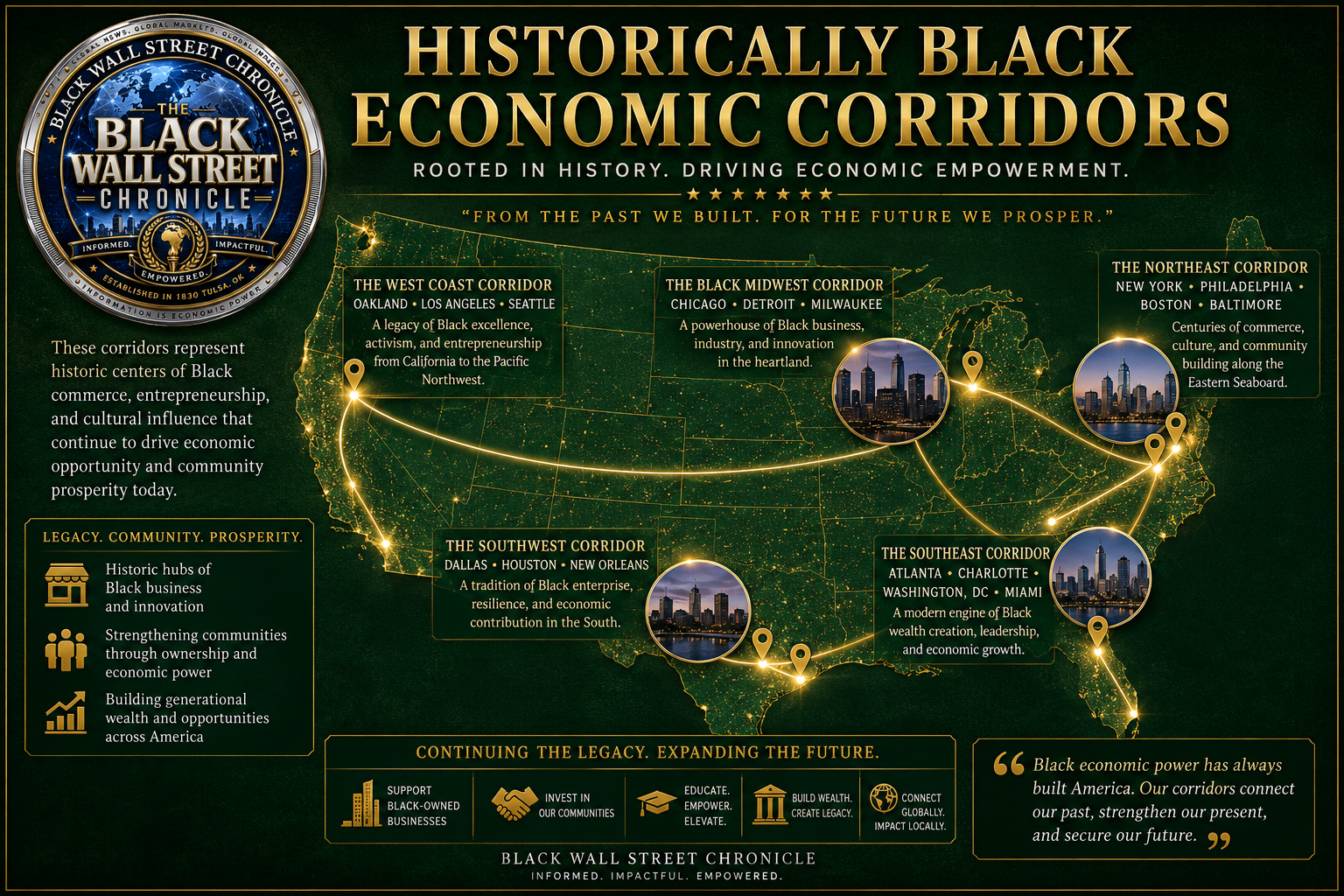
Historical Black Economic Corridors

Black Economic Corridors in the United States
The History of Our Prosperity, Power, and Economic Transformation in America
The Emergence of Parallel Economic Worlds
The formation of Black economic corridors in the United States is best understood as a structural outcome of racial exclusion embedded within American urban development. These corridors were not simply clusters of Black-owned businesses or naturally evolving neighborhoods. They were complex, adaptive economic systems that emerged because African Americans were systematically excluded from full participation in mainstream commercial and financial institutions.
Following emancipation, Black Americans entered cities in increasing numbers during Reconstruction and especially during the Great Migration. They arrived with varying levels of skill, education, and capital, but consistently encountered barriers in housing, employment, banking, and public accommodations. These barriers were not temporary inconveniences; they were structural features of urban life reinforced by law, policy, and private discrimination.
As a result, Black communities developed parallel economic geographies. Within these geographies, entire districts formed that replicated many of the functions of a full city economy. They contained businesses, financial institutions, professional services, cultural venues, and civic organizations. Over time, these corridors became engines of both survival and innovation, shaping Black urban life in profound ways.
Structural Conditions That Produced Black Economic Corridors
The emergence of these corridors cannot be understood without examining the structural conditions that made them necessary. The first of these conditions was residential segregation, which confined Black populations into specific urban areas through restrictive covenants, discriminatory lending practices, and informal enforcement mechanisms. These spatial constraints meant that Black populations became highly concentrated in specific neighborhoods, creating dense local consumer markets.
The second condition was labor market exclusion. African Americans were frequently barred from industrial jobs, craft unions, and professional employment opportunities. This exclusion pushed many into entrepreneurship, informal labor networks, and self-employment. The result was an unusually high density of Black-owned small businesses in urban districts.
The third condition was financial exclusion. Mainstream banks routinely denied credit to Black individuals and business owners, making capital accumulation and expansion extremely difficult. In response, Black communities developed their own financial institutions, including banks, insurance companies, burial societies, and informal lending systems. These institutions became the backbone of Black economic life.
Together, these conditions produced a distinctive economic environment in which Black communities were forced to build self-contained systems of production, exchange, and credit. These systems were not marginal; they were highly structured and often remarkably efficient given the constraints under which they operated.
Greenwood District (Tulsa): Concentrated Wealth and Economic Destruction
The Greenwood District in Tulsa, Oklahoma emerged in the early twentieth century as one of the most economically vibrant Black communities in the United States. Its development was closely tied to the broader economic expansion of Oklahoma during the oil boom, which created opportunities for employment and entrepreneurship.
Because segregation barred Black residents from participating in white commercial districts, entrepreneurs in Tulsa established businesses along Greenwood Avenue that served the Black population exclusively. Over time, this corridor developed into a fully functioning economic district with remarkable diversity. It contained grocery stores that supplied essential goods, hotels that accommodated travelers and workers, medical offices operated by Black physicians and dentists, law practices that served local legal needs, entertainment venues that hosted performances, and newspapers that circulated information within the community.
What distinguished Greenwood was not merely the presence of businesses but the intensity of economic circulation within the district. Money spent in Greenwood tended to remain within the community longer than in many integrated urban economies because there were few external alternatives for goods and services. This created a dense cycle of reinvestment that strengthened local wealth accumulation.
The district was also supported by a strong institutional framework. Churches played a dual role as spiritual centers and informal financial institutions, often providing loans or financial assistance to community members. Fraternal organizations functioned as early insurance systems, offering protection against illness, death, and economic hardship. Civic organizations helped regulate business activity and maintain trust within the local economy.
Despite its strength, Greenwood existed within a broader environment of racial hostility. Its economic success made it both a symbol of Black achievement and a target of resentment. This tension culminated in the destruction of the district during the 1921 Tulsa Race Massacre, in which Greenwood’s entire economic infrastructure was burned and dismantled. The destruction represented not only a human tragedy but also a massive loss of accumulated Black wealth and institutional capacity, the effects of which extended across generations.
Jackson Ward (Richmond): Early Black Financial Architecture
Jackson Ward in Richmond, Virginia represents one of the earliest and most important examples of structured Black economic development in the United States. In the decades following the Civil War, Richmond became a center of Black political and economic activity, and Jackson Ward emerged as its primary commercial district.
Unlike many later Black economic corridors, Jackson Ward developed early financial sophistication. One of its most significant contributions was the establishment of Black-owned banking institutions, most notably the St. Luke Penny Savings Bank founded by Maggie L. Walker. This institution allowed African Americans to access savings accounts, loans, and basic financial services at a time when mainstream banks refused service to Black customers.
The presence of banking institutions enabled the development of a more stable business environment. Black entrepreneurs could secure financing for homes and businesses, while families could begin to accumulate savings in a formalized system. This marked an important transition from purely informal economic survival strategies toward structured financial participation within a segregated system.
Jackson Ward also developed a strong professional class of lawyers, educators, and business owners. These professionals played a key role in maintaining the district’s economic infrastructure and providing services that reinforced internal community stability.
Over time, however, Jackson Ward faced structural pressures from urban redevelopment and shifting economic patterns. These changes gradually weakened its institutional cohesion, though its historical significance as a foundational Black financial district remains central to understanding the development of Black urban economies.
Auburn Avenue (Atlanta): Institutional Capitalism and Economic Self-Determination
Auburn Avenue in Atlanta, Georgia, often referred to historically as “Sweet Auburn,” became one of the most institutionally developed Black economic corridors in the United States. Its significance lies not only in its commercial activity but in its unusually high level of organizational and financial sophistication.
The corridor developed a strong financial ecosystem anchored by Black-owned institutions such as insurance companies and banks. These institutions were critical in enabling wealth accumulation within the Black community. Insurance companies provided financial security for families, while banks offered credit and savings mechanisms that supported entrepreneurship and homeownership.
Unlike many Black districts that relied heavily on small retail businesses, Auburn Avenue developed a more vertically integrated economic structure. Professionals such as doctors, lawyers, and educators formed an interconnected middle class that reinforced the district’s financial stability. These professionals often reinvested their earnings within the community, further strengthening internal economic circulation.
Auburn Avenue also served as a political and civic hub. It was closely associated with Black leadership networks and played a role in the development of civil rights organizing strategies in Georgia and beyond. Churches within the corridor functioned as both spiritual centers and organizational hubs for political coordination and economic support.
Despite its strength, Auburn Avenue eventually experienced decline due to structural changes in urban development. Highway construction physically divided the district, while suburbanization redirected economic activity away from the urban core. These forces weakened the institutional density that had once made the corridor so economically powerful.
U Street Corridor (Washington, D.C.): Cultural Economy and Federal-Class Stability
The U Street Corridor in Washington, D.C. developed into one of the most culturally significant Black economic districts in the United States. Its economy was deeply rooted in entertainment, professional employment, and political activity.
The corridor became famous for its nightlife and entertainment industry, earning the informal designation “Black Broadway.” Jazz clubs, theaters, restaurants, and performance venues formed the core of its economic activity. These establishments attracted both local residents and national performers, creating a vibrant cultural economy.
What distinguished U Street from many other Black economic corridors was the presence of a large Black middle class employed in federal government positions. This stable income base provided consistent consumer spending power, which supported local businesses and allowed the corridor to sustain a relatively robust economy.
U Street also functioned as an intellectual and political gathering space. Black professionals, activists, and cultural figures used the corridor as a site of discussion and coordination, linking economic activity with political consciousness.
Over time, however, the corridor experienced economic disruption as integration, urban change, and shifting residential patterns altered its traditional consumer base.
Harlem (New York): Global Cultural Capital and Economic Paradox
Harlem in New York City became the most internationally recognized Black urban district in the United States. Its significance lies in its dual identity as both a cultural capital and a site of persistent economic inequality.
During the Harlem Renaissance, the district became the center of a global intellectual and artistic movement. Writers, musicians, visual artists, and thinkers transformed Harlem into a symbol of Black modernity and creative expression. This cultural output had global influence, shaping perceptions of Black identity worldwide.
Economically, Harlem contained a dense network of businesses, including publishing houses, entertainment venues, restaurants, and retail establishments. These businesses served a large population of Black migrants from the American South and Caribbean.
However, Harlem also exhibited a structural contradiction. Despite its cultural prominence, it suffered from chronic underinvestment, poor housing conditions, and discriminatory urban policies. This created a disconnect between cultural production and material wealth, limiting long-term economic stability.
Bronzeville (Chicago): Industrial Migration and Urban Economic Expansion
Bronzeville in Chicago developed during the Great Migration as African Americans arrived in large numbers seeking industrial employment. The district became a central hub of Black urban life in the Midwest.
Its economy was closely tied to industrial labor markets, including manufacturing, railroads, and meatpacking industries. This employment base provided income that supported a growing network of Black-owned businesses.
Bronzeville also developed strong institutional infrastructure, including newspapers, insurance companies, churches, and civic organizations. These institutions helped stabilize the community and support economic development.
Culturally, Bronzeville became a major center for jazz and blues innovation, contributing significantly to American musical history.
Expansion of the Black Urban Economic Network
As African American migration intensified during the Great Migration, Black economic corridors expanded beyond the early Southern and Mid-Atlantic centers into the industrial Midwest, the West Coast, and major transportation and tourism hubs. This second wave of corridor development reflects a shift in Black urban life from Reconstruction-era formation toward industrial-age consolidation and cultural-industrial expansion.
Unlike the earlier corridors, which were often anchored in post-emancipation settlement patterns, these later districts developed in response to industrial labor demand, wartime migration, and the expansion of segregated metropolitan regions. They became deeply embedded in urban economies defined by manufacturing, transportation infrastructure, entertainment industries, and automotive or port-based labor systems.
At the same time, these corridors were increasingly vulnerable to mid-20th century urban planning decisions, including freeway construction, urban renewal programs, and industrial restructuring. These forces would later play a major role in their fragmentation or decline.
Detroit: Paradise Valley and Black Bottom as Dual Economic Engines
The Black economic landscape of Detroit was defined primarily by two adjacent districts, Paradise Valley and Black Bottom. Together, they formed one of the most dynamic Black urban economies in the Midwest during the early to mid-20th century.
Paradise Valley developed as an entertainment and commercial hub, while Black Bottom functioned as a dense residential and small business district. Their proximity created a tightly integrated economic system in which housing, labor, retail, and entertainment reinforced one another.
The economic foundation of these districts was closely tied to Detroit’s industrial expansion, particularly the automobile industry. African Americans migrating from the South entered factory labor positions that provided stable wages, which then circulated through local Black-owned businesses. This industrial wage base created a relatively strong internal consumer economy.
Within Paradise Valley, a dense entertainment industry emerged. Nightclubs, theaters, jazz venues, and restaurants formed the core of economic activity. These venues were not merely cultural spaces; they were major economic institutions that generated employment for musicians, service workers, and entrepreneurs. The music industry itself became a significant economic driver, linking Detroit to national jazz and blues networks.
Black Bottom, in contrast, functioned as a residential and commercial support system. It contained grocery stores, barbershops, small retail businesses, and professional services. The interaction between Black Bottom and Paradise Valley created a complete urban ecosystem in which labor, consumption, and entertainment were tightly interwoven.
Despite this complexity, both districts were ultimately destroyed through mid-century urban renewal policies and highway construction projects. These interventions displaced tens of thousands of residents and dismantled the economic infrastructure of the area, replacing it with institutional developments that did not reintegrate displaced Black economic networks.
Los Angeles: Central Avenue and the West Coast Migration Economy
Central Avenue in Los Angeles emerged as the primary Black economic corridor on the West Coast during the Great Migration. Unlike Eastern and Midwestern Black districts, Central Avenue developed within a rapidly expanding metropolitan economy shaped by film, aerospace, port labor, and wartime industrial production.
African American migrants arriving in Los Angeles encountered segregation in housing and employment, which concentrated them in specific neighborhoods along Central Avenue. This concentration created a localized economic ecosystem that quickly expanded in scale and sophistication.
The corridor became internationally known for its jazz scene, which rivaled those of Harlem and Chicago. Nightclubs and performance venues attracted musicians from across the country, making Central Avenue a key node in the national Black cultural economy. These entertainment venues generated employment not only for performers but also for service workers, promoters, and business owners.
Beyond entertainment, Central Avenue also supported a wide range of small businesses, including hotels, restaurants, beauty salons, and retail shops. These businesses served both local residents and transient populations associated with industrial and military employment in the region.
Over time, however, the economic cohesion of Central Avenue was weakened by suburbanization, desegregation, and shifts in industrial geography. As Black residents gained access to previously restricted neighborhoods, economic activity became more dispersed, reducing the concentration effect that had supported the corridor’s earlier vitality.
New Orleans: Claiborne Avenue and the Political Economy of Infrastructure
Claiborne Avenue in New Orleans represents a distinctive form of Black economic corridor shaped by both commercial activity and infrastructural vulnerability.
Prior to its
disruption, Claiborne Avenue functioned as a major commercial artery within Black New Orleans. It contained businesses that served the surrounding residential community, including retail shops, restaurants, professional offices, and cultural venues. The corridor also played a significant role in local social life, particularly through its relationship to Mardi Gras Indian traditions and neighborhood-based cultural organizations.
The economic structure of Claiborne Avenue was deeply integrated into the surrounding residential neighborhoods, which provided a stable consumer base. This integration allowed for consistent circulation of capital within the district, supporting long-term business sustainability.
However, Claiborne Avenue became one of the most significant examples of infrastructure-driven economic destruction in the United States. The construction of Interstate 10 directly over the corridor removed a large portion of its physical and economic infrastructure. The elevated highway not only displaced businesses but also severed the social and economic continuity of the neighborhood.
This intervention demonstrates a broader pattern in American urban development, in which infrastructure projects disproportionately disrupted Black economic districts, often replacing them with transportation systems that benefited regional mobility at the expense of local economic ecosystems.
Miami: Overtown and the Segregated Hospitality Economy
Overtown in Miami developed as a segregated Black neighborhood that functioned as a hospitality and service economy during the era of Jim Crow segregation. Its economic role was closely tied to Miami’s tourism industry, which relied on Black labor while excluding Black patrons from white-owned hotels and entertainment venues.
As a result, Overtown developed its own parallel hospitality infrastructure. Hotels, restaurants, and entertainment venues served Black travelers who were barred from accommodations elsewhere in the city. This created a concentrated service economy that supported both local residents and transient populations.
The district also became a cultural hub, with music and performance venues contributing to its economic vitality. Like other Black economic corridors, Overtown’s cultural life was deeply intertwined with its economic structure, as entertainment venues provided both employment and revenue generation.
However, Overtown experienced severe disruption due to highway construction and urban renewal programs in the mid-20th century. These projects displaced large portions of the population and fragmented the economic continuity of the district, significantly weakening its commercial base.
Memphis: Beale Street and Music as Economic Infrastructure
Beale Street in Memphis represents one of the clearest examples of music functioning as a central economic engine within a Black urban corridor.
The district developed as a commercial and entertainment hub where blues music was not simply cultural expression but a foundational component of economic activity. Clubs, restaurants, and performance venues generated employment for musicians, service workers, and business owners. The circulation of visitors and performers created a dynamic local economy tied to national music networks.
Beale Street also functioned as a commercial district with retail shops and small businesses that served the surrounding Black community. However, its identity was most strongly shaped by its role in the development and commercialization of blues music, which became one of the most influential cultural exports of the United States.
Over time, the district was affected by broader urban redevelopment patterns and changes in the structure of the music industry, particularly the shift toward recording technologies and national distribution networks that reduced the centrality of localized performance corridors.
Durham: Hayti District and Black Corporate Capitalism
The Hayti District in Durham, North Carolina represents one of the most advanced examples of Black corporate economic development in the United States.
Unlike many Black economic corridors that relied primarily on small businesses, Durham developed large-scale Black-owned corporations, most notably North Carolina Mutual Life Insurance Company. This institution became one of the largest Black-owned businesses in American history and provided insurance, financial services, and investment mechanisms for Black communities across the region.
The presence of such institutions created a highly structured economic environment in which professional classes, entrepreneurs, and service providers could operate within a stable financial ecosystem. The district included banks, insurance firms, retail businesses, and professional offices that collectively formed a sophisticated urban economy.
Hayti’s economic success was closely tied to its institutional depth. Churches, schools, and civic organizations reinforced the district’s economic stability by providing education, social cohesion, and leadership development.
However, like many other Black economic corridors, Hayti was significantly disrupted by urban renewal projects and highway construction, which fragmented its physical and economic structure.
Consolidation, Disruption, and the End of the Corridor Era
By the mid-20th century, Black economic corridors across the United States entered a period of profound transformation. The forces that had originally created these districts—segregation, exclusion, and concentrated settlement—were beginning to shift. Legal segregation was being dismantled, migration patterns were changing, and urban redevelopment programs were reshaping American cities from the ground up.
However, the removal of formal segregation did not result in the preservation of Black economic concentration. Instead, it produced a paradox: as barriers to movement and residence decreased, Black populations and capital became more geographically dispersed. At the same time, large-scale infrastructure projects, including highways and urban renewal schemes, physically dismantled many of the remaining corridors.
The final group of Black economic districts reflects this transitional period, where long-established systems were either fragmented, displaced, or fundamentally altered by modern urban planning.
Parramore (Orlando): Segregated Growth and Controlled Economic Space
Parramore in Orlando developed as a segregated Black neighborhood shaped by the tourism economy of central Florida. Like many Southern Black districts, it emerged under Jim Crow segregation, which restricted African Americans to designated residential and commercial zones.
Within this constrained geography, Parramore developed a self-sustaining local economy. Small businesses, churches, schools, and service providers formed the backbone of daily life. These institutions were tightly interwoven with residential patterns, creating a compact economic ecosystem that served the surrounding Black population.
The economic structure of Parramore was closely tied to labor markets in hospitality, domestic service, construction, and railroad work. Wages earned in these sectors circulated locally through Black-owned businesses, reinforcing internal economic dependency within the district.
However, Parramore’s long-term development was constrained by limited access to external capital and by later urban redevelopment efforts that redirected investment toward Orlando’s tourism core. Over time, the district experienced disinvestment and fragmentation, reflecting a broader pattern in which Black economic spaces were deprioritized in metropolitan planning.
Farish Street (Jackson): Deep South Commercial Continuity
Farish Street in Jackson, Mississippi represents one of the most historically significant Black commercial corridors in the Deep South. Unlike newer industrial-era districts, Farish Street developed gradually as a central hub of Black life in a state deeply structured by Jim Crow segregation.
The corridor contained a dense network of Black-owned businesses, including retail shops, restaurants, barber shops, hotels, and professional offices. These businesses served a primarily Black clientele excluded from white commercial districts.
Farish Street’s economic strength was rooted in its continuity. It functioned not only as a commercial corridor but as a cultural and social anchor for Black Jackson. Churches and civic organizations played an essential role in reinforcing the district’s cohesion, providing both moral leadership and organizational structure.
However, Farish Street faced long-term decline due to economic disinvestment, suburbanization, and shifts in regional commerce. Despite preservation efforts, its historical role as a central Black economic hub reflects the broader trajectory of Southern Black commercial districts under changing urban conditions.
Wilmington: Political Destruction and Economic Collapse
Wilmington, North Carolina represents a different type of economic transformation, one defined not by gradual decline but by abrupt political violence.
In the late 19th century, Wilmington contained one of the most prosperous Black middle-class communities in the South. African Americans held political office, owned businesses, and participated in a multiracial coalition government during Reconstruction.
However, in 1898, a violent coup d’état led by white supremacist forces overthrew the city government, killed Black residents, and destroyed Black-owned businesses. This event effectively dismantled Wilmington’s Black economic and political infrastructure.
The Wilmington coup is significant because it demonstrates that Black economic success was not only vulnerable to market forces or urban redevelopment, but also to direct political violence. The destruction of Black economic power in Wilmington set a precedent for later forms of economic displacement through both legal and extralegal means.
Philadelphia Seventh Ward: Urban Sociology and Mutual Aid Networks
The Seventh Ward in Philadelphia occupies a unique place in the study of Black urban life because it was extensively documented by W.E.B. Du Bois in his sociological work on Black communities.
The district functioned as a dense urban neighborhood with a combination of working-class and middle-class Black residents. Its economy included small businesses, domestic labor networks, churches, and mutual aid societies.
Unlike some more commercially concentrated corridors, the Seventh Ward’s economic life was deeply embedded in household and community structures. Employment was often informal or service-based, but it was stabilized by strong kinship and organizational networks.
Mutual aid societies played a particularly important role, providing financial assistance for illness, death, and unemployment. These organizations functioned as early forms of social insurance in the absence of state support.
The Seventh Ward demonstrates how Black economic life was not only structured through formal business districts but also through social institutions embedded in residential neighborhoods.
Oakland Seventh Street: Industrial Migration and West Coast Black Economy
Seventh Street in Oakland, California developed as a major Black economic corridor during the Second Great Migration, when African Americans moved to the West Coast to work in wartime and industrial industries.
Oakland’s port, rail, and shipbuilding industries provided employment opportunities that attracted large numbers of Black migrants. Seventh Street emerged as the primary commercial and cultural hub for this population.
The corridor contained a dense mix of Black-owned businesses, including retail shops, restaurants, hotels, and entertainment venues. It also became a major center for jazz and blues performance on the West Coast, linking Oakland to national cultural networks.
Seventh Street’s economy was closely tied to industrial labor markets, meaning that its prosperity depended on wage stability in manufacturing and transportation sectors. When industrial restructuring began in the postwar period, the economic base of the corridor weakened.
A major turning point came with the construction of the Cypress Freeway, which physically cut through the district and destroyed much of its commercial infrastructure. This intervention represents one of the most explicit examples of infrastructure-driven displacement of a Black economic corridor in American history.
Comparative Synthesis: Structural Patterns Across All Corridors
When examining Black economic corridors across the United States as a unified system, several consistent structural patterns emerge.
First, these corridors were produced through spatial concentration. Segregation created dense Black urban populations that formed strong internal markets. This concentration was not accidental but structurally enforced through housing policy and discrimination.
Second, these districts developed parallel financial systems. Because access to mainstream banking was restricted, Black communities created their own financial institutions, including banks, insurance companies, and mutual aid societies. These institutions provided the capital necessary for business development and household stability.
Third, cultural production functioned as an economic engine. Music, theater, and entertainment were not secondary activities but central components of economic life. In places like Beale Street, U Street, and Central Avenue, cultural industries directly sustained local economies.
Fourth, infrastructure projects repeatedly disrupted Black economic continuity. Highways, urban renewal programs, and redevelopment initiatives often targeted the physical space of Black districts, resulting in displacement and fragmentation of economic networks.
Finally, economic success within these corridors often generated external pressure. Prosperous Black districts frequently became targets of political hostility, redevelopment, or economic diversion.
The Legacy of a Parallel Economic System
The history of Black economic corridors in the United States reveals the existence of a parallel economic system built under conditions of exclusion. From early districts such as Jackson Ward and Auburn Avenue to industrial-era corridors like Bronzeville and Central Avenue, and later transitional districts such as Overtown and Seventh Street Oakland, these spaces formed a coherent national geography of Black economic life.
They demonstrate that African American communities did not merely participate in the U.S. economy under constraint—they actively constructed alternative economic systems with their own institutions, markets, and cultural infrastructures.
At the same time, these corridors reveal the structural vulnerability of Black economic success within the broader context of American urban development. Repeated cycles of displacement, destruction, and disinvestment highlight the tension between Black economic innovation and the political and spatial structures of the cities in which they were embedded.
Understanding these corridors is essential for understanding American economic history itself. They are not peripheral stories. They are central to the formation of American urban capitalism, cultural production, and spatial inequality.
From Corridor Systems to Fragmented Urban Economies
The Black economic corridors described in earlier sections were largely products of a specific historical era defined by segregation, industrial expansion, and constrained mobility. By the late 1960s and accelerating through the 1980s and beyond, the structural conditions that produced these corridors began to shift in ways that fundamentally altered their economic logic.
Legal segregation was dismantled through civil rights legislation, but economic integration did not occur evenly or uniformly. Instead, Black populations experienced a new spatial and economic dynamic: dispersal without equivalent capital accumulation. At the same time, deindustrialization, urban renewal, and infrastructure restructuring reshaped the physical and economic landscapes of American cities.
What emerged was not a simple continuation of earlier Black economic corridors, but a fragmented system in which former centers of Black economic life were either partially preserved, deeply transformed, or entirely displaced.
Deindustrialization and the Collapse of Wage-Based Urban Economies
One of the most important structural shifts affecting Black economic corridors was the decline of industrial employment in American cities. Many of the most vibrant Black districts, including Bronzeville in Chicago, Paradise Valley in Detroit, and Seventh Street in Oakland, were deeply tied to manufacturing, railroads, automotive production, and port labor.
As manufacturing jobs began to move to suburban locations, other regions of the United States, and eventually overseas, the wage base that supported these corridors weakened significantly. The economic model that had sustained dense Black urban neighborhoods—steady industrial employment feeding local business ecosystems—began to erode.
This shift had cascading effects. Without stable wages circulating through local economies, small businesses lost consistent consumer demand. Entertainment districts became more reliant on external visitors rather than local spending power. Housing markets destabilized as unemployment increased and property values fluctuated.
The result was a gradual but persistent weakening of the economic foundations that had supported Black urban corridors for decades.
Federal Policy and the Reengineering of Urban Space
Beyond economic restructuring, federal and municipal policy played a decisive role in reshaping Black economic corridors. One of the most significant mechanisms was urban renewal policy, often summarized by the phrase “negro removal,” reflecting its disproportionate impact on Black neighborhoods.
Urban renewal programs frequently targeted areas labeled as “blighted,” a designation that was often applied to densely populated Black districts regardless of their economic activity. Entire neighborhoods were cleared to make way for highways, civic centers, and commercial redevelopment projects.
In many cases, these projects did not simply displace residents; they physically destroyed the spatial continuity of Black economic corridors. Claiborne Avenue in New Orleans is a particularly clear example, where Interstate 10 was constructed directly through a thriving Black commercial corridor, severing its economic core.
Similarly, highway construction in cities like Detroit and Oakland cut through Paradise Valley, Black Bottom, and Seventh Street, fragmenting previously integrated economic systems. These interventions were not neutral infrastructure decisions; they reshaped the geography of opportunity and disinvestment.
Federal housing policy also reinforced spatial inequality. Mortgage lending systems, particularly those influenced by Federal Housing Administration guidelines, systematically favored suburban white homeownership while excluding Black neighborhoods from capital investment. This created a dual housing market in which wealth accumulation through property ownership became increasingly unequal.
Suburbanization and the Dispersal of Black Economic Density
Another major transformation was suburbanization. As legal barriers to residential mobility weakened, many middle-class Black families moved out of historic urban corridors into suburban areas. This shift had complex consequences.
On one hand, suburbanization represented expanded geographic freedom and access to new housing opportunities. On the other hand, it contributed to the dispersal of Black consumer markets that had previously supported dense urban business ecosystems.
In earlier eras, Black economic corridors functioned because populations were concentrated within limited geographic spaces. Businesses could rely on a stable, nearby customer base. As populations dispersed, economic activity became more spread out, reducing the viability of highly concentrated Black commercial districts.
This dispersal also weakened institutional density. Churches, fraternal organizations, and local businesses that had once operated in close proximity now became geographically separated. The social and economic feedback loops that sustained corridor economies became less efficient.
Gentrification and the Revaluation of Historic Black Districts
Beginning in the late 20th century and accelerating into the 21st century, many historic Black economic corridors underwent processes of gentrification. Unlike earlier forms of displacement driven by highways or industrial restructuring, gentrification involved market-driven reinvestment and demographic change.
Neighborhoods such as Harlem, U Street, Central Avenue, and parts of Bronzeville experienced rising property values and new commercial development. However, this reinvestment often occurred without proportional retention of original Black residents or businesses.
The economic logic of gentrification is rooted in capital revaluation. Areas that were previously disinvested become attractive due to proximity to urban cores, cultural heritage, or infrastructure access. As investment flows in, property values rise, often exceeding the economic capacity of long-term residents.
This process transforms the function of former Black economic corridors. Instead of serving as internally circulating economies anchored in Black ownership, they become mixed-use or externally driven markets where cultural legacy is often commodified but not institutionally controlled by the original community.
Harlem is one of the most prominent examples of this transformation. While still culturally significant, its economic structure has shifted toward higher-income housing, national retail chains, and external investment capital. Similar dynamics have occurred in parts of Washington, D.C., Los Angeles, and Chicago.
The Rise of Neo-Corridors and Distributed Black Economic Space
Despite the fragmentation of historic corridors, new forms of Black economic geography have emerged in the contemporary era. These are not always spatially concentrated in the same way as earlier districts, but they reflect new configurations of Black economic activity.
In cities such as Atlanta, Houston, and parts of the Washington, D.C. metropolitan area, Black entrepreneurship has expanded into suburban and mixed urban-suburban environments. Instead of a single concentrated corridor, economic activity is distributed across multiple nodes, including business districts, digital enterprises, and service networks.
This shift reflects broader changes in the economy, particularly the rise of service industries, digital entrepreneurship, and decentralized business models. However, it also reflects the continued importance of spatial clustering, even if in more fragmented forms.
At the same time, cultural production continues to function as an economic anchor. Music, media, fashion, and entertainment industries remain deeply influenced by Black cultural innovation, even when production is no longer geographically concentrated in traditional corridors.
The Persistence of Structural Inequality in New Economic Forms
Although the spatial form of Black economic life has changed, many structural inequalities remain consistent. Access to capital continues to be uneven, with Black entrepreneurs facing higher barriers to credit and investment. Property ownership gaps persist, affecting long-term wealth accumulation.
In addition, the displacement of historic Black corridors has long-term implications for intergenerational wealth transfer. The destruction of places like Greenwood, Black Bottom, and Paradise Valley eliminated not only businesses but also accumulated property ownership that could have served as a foundation for future economic stability.
Even in cases where physical neighborhoods remain intact, economic control often shifts toward external investors. This creates a situation in which cultural and historical identity may remain visible, but economic ownership becomes increasingly externalized.
From Concentrated Corridors to Fragmented Networks
The transformation of Black economic corridors in the post-industrial era reflects a fundamental restructuring of urban space in the United States. The tightly concentrated, institutionally dense corridors of the early and mid-20th century have largely been replaced by more fragmented and distributed economic networks.
This shift has been driven by multiple forces: deindustrialization, federal infrastructure policy, suburbanization, gentrification, and changes in the structure of the national economy. Together, these forces have reshaped the geography of Black economic life.
Yet despite this transformation, the legacy of the original corridors remains central. They demonstrate that Black economic systems were never marginal or informal; they were structured, complex, and highly adaptive responses to exclusion. They also demonstrate the recurring tension between Black economic success and the spatial and political forces that repeatedly reshaped or dismantled it.
Understanding both the historical corridors and their modern transformations is essential for understanding the full trajectory of Black urban economic life in the United States. It is not a story of disappearance, but of continuous restructuring under changing conditions of power, space, and capital.
Black US Population Index
Black Wall Street Chronicle Research Index