
After 250 Years: Black Business In America
Live

Wealth Creation & Economic Self-Determination

The story of Black business in America is one of the most remarkable yet often underappreciated narratives in the history of the United States. It is a story forged through centuries of adversity, innovation, resilience, and determination. Black entrepreneurship has never been solely about commerce. Rather, it has served as a vehicle for freedom, self-sufficiency, community development, political influence, and intergenerational wealth creation. In many respects, the history of Black business mirrors the broader history of African Americans themselves—a continuous struggle to secure economic independence in a society that has frequently imposed structural barriers to advancement.
As the United States moves through 2026, Black-owned businesses occupy an increasingly significant position within the national economy. According to available business ownership data, millions of Black-owned firms collectively contribute hundreds of billions of dollars in economic activity annually while providing employment opportunities across nearly every sector of the American economy. Black entrepreneurs today are launching technology startups, operating manufacturing facilities, managing construction companies, creating financial services firms, developing artificial intelligence applications, producing media content, investing in commercial real estate, and engaging in global trade. Their influence extends far beyond traditional notions of minority business ownership and reflects a growing presence within the broader architecture of American capitalism.
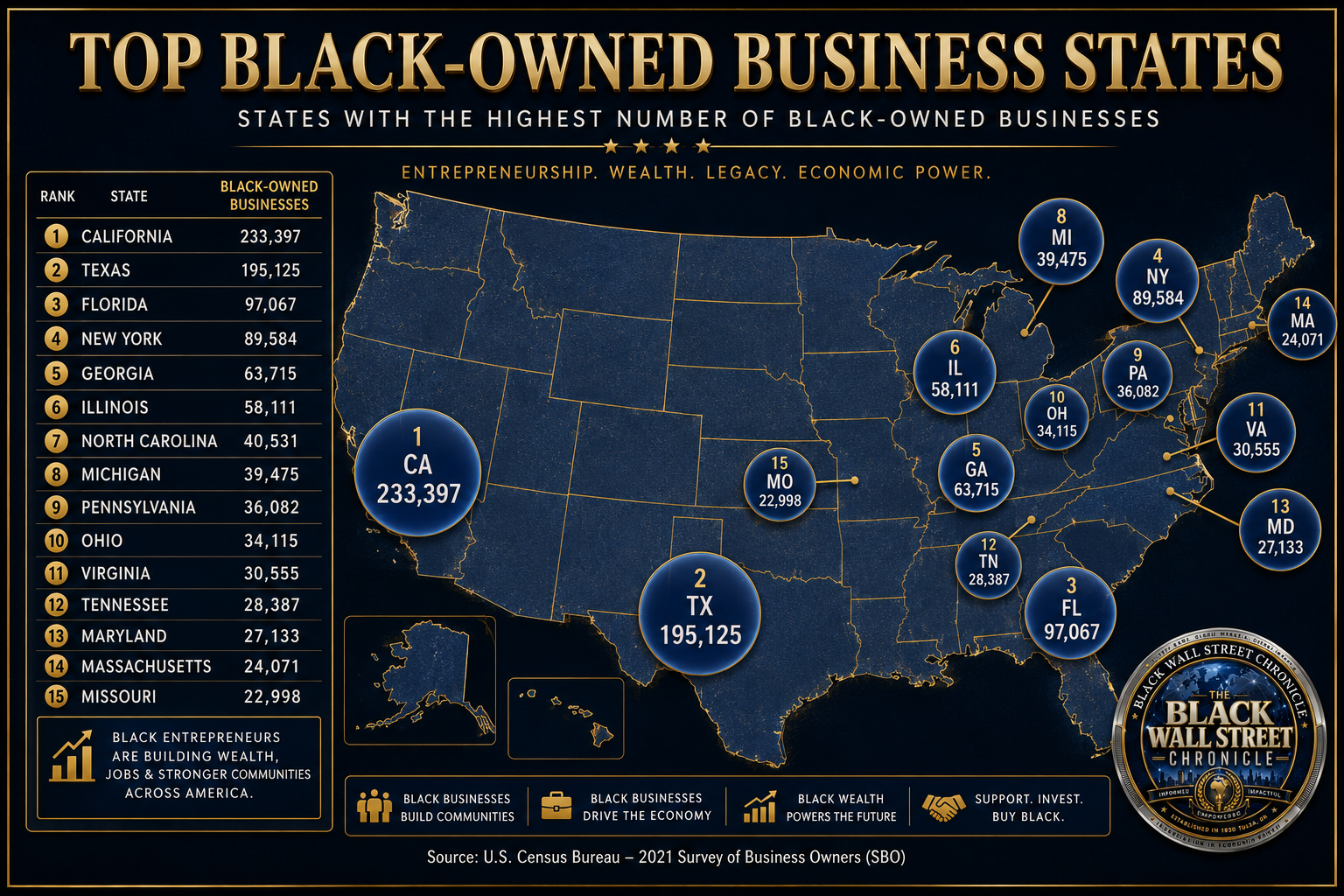
The geographic distribution of Black-owned businesses reveals important concentrations of entrepreneurial activity. California leads the nation with approximately 233,397 Black-owned businesses, followed by Texas with 195,125 and Florida with 97,067. New York ranks fourth with 89,584 Black-owned businesses, while Georgia follows closely with 63,715. Illinois, North Carolina, Michigan, Pennsylvania, Ohio, Virginia, Tennessee, Maryland, Massachusetts, and Missouri round out the fifteen states with the highest concentrations of Black-owned enterprises. These numbers represent far more than statistical abstractions. Behind every business is an individual or family seeking to build prosperity, create opportunity, and contribute to the economic life of their communities.
The growth of Black entrepreneurship in America has attracted increasing attention from scholars and researchers across numerous academic institutions. Organizations such as the African American Research Collaborative at Arizona State University, the Hutchins Center for African and African American Research at Harvard University, the Institute for Research in African-American Studies at Columbia University, the Africana Studies and Research Center at Cornell University, the Kirwan Institute for the Study of Race and Ethnicity, the W. E. B. Du Bois Research Institute at Harvard University, and the National Museum of African American History and Culture have all contributed important insights regarding the historical and contemporary dimensions of Black economic development. Their collective scholarship demonstrates that Black business ownership remains one of the most important mechanisms through which African Americans pursue economic mobility, community empowerment, and wealth accumulation.
At the same time, persistent challenges continue to shape the entrepreneurial landscape. Black business owners often encounter disparities in access to capital, lending opportunities, venture investment, commercial real estate acquisition, procurement contracts, and intergenerational wealth transfers. These barriers are neither accidental nor isolated. Rather, they reflect historical patterns of exclusion that have shaped economic outcomes for generations. Understanding Black business in 2026 therefore requires both an appreciation of contemporary achievements and a recognition of the historical forces that continue to influence economic opportunity.
This article examines the state of Black business in America in 2026 through historical, economic, technological, social, and global lenses. Drawing upon research from leading academic institutions and the ongoing work of organizations such as Black Wall Street USA and BlackWallStreet.org, it explores the achievements, challenges, and future prospects of Black entrepreneurship in the United States.
Historical Foundations of Black Entrepreneurship
The foundations of Black business in America were established long before emancipation. During slavery, African Americans developed a vast range of specialized skills that contributed significantly to the economic development of the United States. Enslaved artisans worked as blacksmiths, carpenters, masons, seamstresses, shipbuilders, engineers, agricultural specialists, and merchants. Although the fruits of their labor were largely appropriated by slaveholders, these skills laid the groundwork for future entrepreneurial activity following emancipation.
The period immediately following the Civil War witnessed an extraordinary surge of Black economic activity. Despite possessing little accumulated wealth and facing violent opposition throughout much of the country, African Americans established farms, retail stores, newspapers, schools, churches, insurance companies, and banks. Scholars associated with the Moorland-Spingarn Research Center at Howard University and the Schomburg Center for Research in Black Culture have documented the remarkable pace at which formerly enslaved individuals sought to build independent economic institutions. Entrepreneurship became a means of survival as well as a declaration of freedom.
By the late nineteenth century, Black business leaders such as Madam C. J. Walker, Robert Church, Maggie Lena Walker, Alonzo Herndon, and numerous others had established enterprises that served growing Black communities throughout the nation. Their success demonstrated that Black entrepreneurship could flourish even within an environment characterized by segregation, discrimination, and restricted access to capital. These business leaders understood that economic independence represented a critical foundation for broader social and political advancement.
Perhaps the most famous example of Black economic achievement emerged in the Greenwood District of Tulsa, Oklahoma. Often referred to as Black Wall Street, Greenwood became one of the most prosperous Black communities in the United States during the early twentieth century. The district contained banks, hotels, theaters, medical practices, restaurants, retail establishments, newspapers, and numerous other businesses. Residents circulated money within the community, creating a vibrant economic ecosystem that generated wealth and opportunity.
The destruction of Greenwood during the Tulsa Race Massacre of 1921 remains one of the most devastating attacks on economic prosperity in American history. Yet the legacy of Black Wall Street continues to inspire entrepreneurs more than a century later. Organizations such as Black Wall Street USA and BlackWallStreet.org have sought to revive the principles of ownership, investment, entrepreneurship, and economic cooperation that characterized Greenwood's success. Their efforts reflect a growing recognition that sustainable economic empowerment requires not only individual achievement but also collective investment and institutional development.
The Economic Significance of Black-Owned Businesses in 2026
The economic influence of Black-owned businesses has expanded considerably during the twenty-first century. Black entrepreneurs now participate in virtually every major sector of the economy, ranging from healthcare and finance to technology and advanced manufacturing. This diversification represents a significant departure from earlier periods in American history when Black businesses were often confined to serving segregated markets or operating within narrowly defined industries.
The modern Black business ecosystem contributes substantially to employment creation and economic output. Small businesses remain the backbone of Black entrepreneurship, yet increasing numbers of Black-owned firms have achieved regional, national, and even international prominence. Entrepreneurs are leveraging technology, social media, e-commerce platforms, and digital payment systems to reach customers beyond traditional geographic boundaries. As a result, the potential market for Black-owned businesses has expanded dramatically.
The importance of Black-owned businesses extends beyond conventional economic metrics. Research conducted by institutions such as the Center for Race, Ethnicity and Equity at Washington University in St. Louis and the Institute for Black Intellectual and Cultural Life at Dartmouth College suggests that business ownership often produces broader social benefits. Business owners frequently serve as community leaders, philanthropists, mentors, and advocates for local development. Their enterprises provide employment opportunities, support neighborhood revitalization efforts, and contribute to local tax bases.
Moreover, Black-owned businesses play a critical role in addressing longstanding disparities in wealth accumulation. While income provides short-term financial stability, business ownership offers opportunities for long-term wealth creation. Successful enterprises generate assets that can be transferred across generations, thereby contributing to the development of family wealth. In a nation where significant racial wealth disparities persist, the expansion of Black business ownership represents a potentially transformative force.
The growing prominence of Black entrepreneurship has also attracted increased attention from investors, policymakers, and corporate leaders. Supplier diversity initiatives, targeted investment funds, and entrepreneurial support programs have expanded in recent years. While such efforts do not eliminate structural barriers, they indicate a broader recognition of the economic value and potential of Black-owned enterprises.
The Geography of Black Enterprise in America
The distribution of Black-owned businesses across the United States reflects both historical migration patterns and contemporary economic opportunities. California's position as the leading state for Black-owned businesses illustrates the importance of population size, economic diversification, technological innovation, and access to global markets. Cities such as Los Angeles, Oakland, Sacramento, and San Diego continue to support thriving entrepreneurial communities engaged in industries ranging from entertainment and logistics to healthcare and technology.
Texas has emerged as another major center of Black entrepreneurship. Houston, Dallas-Fort Worth, Austin, and San Antonio have attracted entrepreneurs seeking business-friendly regulatory environments, growing populations, and expanding economic opportunities. The state's diverse economy and strategic location have made it particularly attractive to business owners involved in technology, energy, transportation, and professional services.
Florida's growing Black business sector reflects the state's expanding population, tourism industry, healthcare sector, and international trade connections. Miami's role as a gateway to Latin America and the Caribbean has created unique opportunities for entrepreneurs interested in global commerce. Meanwhile, Atlanta's status as one of the nation's most influential centers of Black economic activity continues to strengthen Georgia's entrepreneurial ecosystem.
Wealth Creation, Capital Formation, and the Continuing Challenge of Economic Equity
Despite the remarkable growth of Black entrepreneurship in recent decades, the issue of wealth accumulation remains one of the most consequential challenges confronting Black America in 2026. Scholars affiliated with institutions such as the Hutchins Center at Harvard University, the Kirwan Institute for the Study of Race and Ethnicity, the Legacies of Slavery Initiative at Brown University, the Slavery and Justice Center at Brown University, the Centre for Reparations Research at the University of the West Indies, and the UCL Centre for Legacies of Slavery have extensively documented how historical barriers to property ownership, credit access, educational opportunity, and inheritance continue to influence contemporary economic outcomes.
While business ownership has always been one of the most effective pathways toward wealth creation, Black entrepreneurs frequently begin their journeys with fewer financial resources than many of their counterparts. The consequences of this reality extend beyond individual firms. Lower levels of inherited wealth often mean less startup capital, reduced access to collateral for loans, fewer family investment networks, and greater personal financial risk when launching or expanding a business. As a result, many Black entrepreneurs are forced to rely on personal savings, consumer credit, or informal financing arrangements to fund their ventures.
This dynamic creates a paradox that has long characterized Black business development in America. Entrepreneurship is often viewed as a solution to wealth disparities, yet wealth disparities themselves can make entrepreneurship more difficult. The challenge is not simply starting businesses but creating businesses that can scale, generate substantial profits, acquire assets, and survive across generations. Wealth is built not only through income but through ownership. It is accumulated through equity, investments, commercial property, intellectual property, and businesses that appreciate in value over time.
Researchers at the African American Research Collaborative at Arizona State University and the Institute for Research in African-American Studies at Columbia University have increasingly emphasized the importance of understanding entrepreneurship within broader systems of economic mobility. Their findings suggest that Black business ownership should not be viewed merely as a matter of individual ambition. Rather, it must be understood as part of a larger ecosystem involving education, public policy, financial institutions, community development, and social networks. When these systems function effectively, entrepreneurship becomes a powerful engine of wealth creation. When they fail, business owners often encounter barriers that limit growth and sustainability.
The future of Black economic advancement will therefore depend not only on increasing the number of Black-owned businesses but also on strengthening their capacity to generate lasting wealth. This distinction is critical. A large number of small businesses can create economic activity, but a robust ecosystem of scalable enterprises can create transformational wealth. The challenge facing Black America in 2026 is to cultivate both.
Access to Capital and the Financing Gap
No discussion of Black business can be complete without examining access to capital. For generations, scholars and policymakers have identified financing as one of the most significant obstacles confronting Black entrepreneurs. Research conducted by institutions including the Center for Race, Ethnicity and Equity, Yale University's Equity Research and Innovation Center, the Race Center for Comparative Studies in Race and Ethnicity at Stanford University, and Project Implicit at Harvard University has repeatedly demonstrated disparities in lending outcomes, investment patterns, and financial accessibility.
The issue extends beyond traditional bank loans. Venture capital funding, angel investment networks, private equity partnerships, and institutional investment vehicles remain disproportionately concentrated among founders who possess extensive financial connections and social capital. Because Black entrepreneurs have historically been excluded from many of these networks, they often face greater challenges securing growth capital.
Nevertheless, important changes have emerged over the past decade. Community development financial institutions, minority depository institutions, fintech lenders, crowdfunding platforms, and impact investment funds have created new avenues through which entrepreneurs can access funding. These innovations have helped reduce some barriers while introducing alternative models for capital formation.
The emergence of technology-driven financial platforms has been particularly significant. Digital lending systems, peer-to-peer financing networks, and crowdfunding initiatives have enabled entrepreneurs to bypass some traditional gatekeepers. In many cases, these platforms evaluate businesses using broader criteria than conventional lending institutions, thereby expanding opportunities for founders who may lack substantial collateral or extensive credit histories.
Organizations such as Black Wall Street USA and BlackWallStreet.org have also emphasized the importance of economic circulation within Black communities. Their advocacy reflects a longstanding principle of economic development: capital retention matters. Communities that invest in their own businesses, institutions, and entrepreneurs are often better positioned to generate sustainable growth over time. The challenge is not simply attracting external investment but also fostering internal investment cultures capable of supporting emerging enterprises.
The Rise of Black Women Entrepreneurs
One of the most important developments in American entrepreneurship during the twenty-first century has been the extraordinary growth of Black women-owned businesses. Across numerous industries, Black women have emerged as one of the fastest-growing entrepreneurial groups in the nation. Their success reflects both necessity and innovation. Many Black women have launched businesses in response to labor market challenges, while others have pursued entrepreneurial opportunities created by technological change and evolving consumer markets.
Research conducted by institutions such as the Africana Studies and Research Center at Cornell University, the Institute for Black Intellectual and Cultural Life at Dartmouth College, and the Griot Institute at Bucknell University highlights the multifaceted contributions of Black women entrepreneurs. Their enterprises span industries including healthcare, education, beauty and wellness, consulting, technology, media production, financial services, and e-commerce.
Despite these achievements, Black women entrepreneurs often encounter unique obstacles. Studies consistently indicate that they receive a disproportionately small share of venture capital funding relative to their contributions and business growth rates. Yet their resilience has become one of the defining characteristics of contemporary Black entrepreneurship. Many have built successful enterprises despite limited external financing, demonstrating remarkable adaptability and strategic ingenuity.
The influence of Black women entrepreneurs extends far beyond economics. Their businesses frequently serve as centers of mentorship, community engagement, and social innovation. In many communities, Black women-owned enterprises function as anchors of local economic development while simultaneously addressing broader social needs. Their contributions illustrate how entrepreneurship can generate both financial and social returns.
The continued growth of Black women-owned businesses may ultimately become one of the most transformative economic developments of the coming decade. As more entrepreneurs gain access to capital, technology, and national markets, their impact on wealth creation and economic mobility is likely to expand significantly.
Technology, Artificial Intelligence, and the Future of Black Enterprise
The rise of artificial intelligence represents one of the most consequential economic developments of the modern era. For Black-owned businesses, AI offers both extraordinary opportunities and significant challenges. The integration of artificial intelligence into business operations is rapidly transforming industries ranging from marketing and logistics to healthcare and financial services.
Historically, access to advanced technology often required substantial financial resources. Today, however, cloud-based platforms and software-as-a-service models have dramatically lowered entry barriers. Entrepreneurs can now utilize sophisticated tools for customer relationship management, data analysis, advertising optimization, inventory management, and financial forecasting without making massive upfront investments.
Researchers affiliated with institutions such as the Black Think Tank at Duke University, the Center for African and African American Research at Duke University, and the Institute for Global African Diaspora at Howard University have increasingly examined the implications of emerging technologies for marginalized communities. Their work suggests that technological literacy and innovation capacity will play critical roles in determining future economic outcomes.
Artificial intelligence has the potential to level certain aspects of the entrepreneurial playing field. Small firms can now automate tasks that once required large administrative staffs. Marketing campaigns can be optimized using machine learning algorithms. Customer service can be enhanced through AI-powered communication systems. Data-driven decision-making tools can improve efficiency and profitability.
Yet technological disruption also presents risks. Automation may displace workers in industries where many African Americans remain concentrated. Businesses that fail to adopt new technologies may find themselves unable to compete effectively. Consequently, educational institutions, workforce development organizations, and entrepreneurial support networks must prioritize technological preparedness as a central component of economic development strategies.
The entrepreneurs who thrive in the coming decade will likely be those who combine traditional business acumen with technological sophistication. For Black-owned businesses, the AI revolution may represent one of the greatest opportunities for accelerated growth since the emergence of the internet itself.
Higher Education, Research Institutions, and Entrepreneurial Development
The growth of Black entrepreneurship has been strongly influenced by the expanding role of universities, research centers, and academic institutions. Throughout the United States and internationally, scholars have contributed valuable insights into the historical, social, and economic dimensions of Black enterprise.
Institutions such as the African and African Diaspora Studies Department at UC Berkeley, the African Studies Center at the University of Pennsylvania, the African Diaspora Research Institute at Georgia State University, the Howard University Center for African Studies, the Institute of African Studies at Emory University, and the Oxford Centre for African Studies have all advanced understanding of the global dimensions of Black economic development.
At the same time, Historically Black Colleges and Universities continue to serve as critical engines of entrepreneurial advancement. HBCUs have long provided educational opportunities for students who were excluded from other institutions. Today, they are increasingly functioning as incubators of innovation, supporting startups, technology ventures, and business development initiatives.
Entrepreneurship programs, accelerator networks, mentorship initiatives, and business competitions have become common features of higher education. These programs provide aspiring entrepreneurs with practical skills, professional networks, and access to resources that can significantly enhance business success.
Perhaps most importantly, academic institutions help shape the intellectual frameworks through which economic development is understood. By documenting historical experiences, analyzing contemporary trends, and evaluating policy interventions, researchers provide essential knowledge that informs both public debate and practical decision-making.
The relationship between scholarship and entrepreneurship is often underestimated. Yet throughout history, ideas have frequently preceded economic transformation. The institutions studying Black economic development today are helping shape the policies, strategies, and innovations that may define the future of Black business tomorrow.
Corporate Procurement, Supplier Diversity, and Economic Expansion
One of the most important developments affecting Black-owned businesses in the twenty-first century has been the growing recognition of supplier diversity as an economic strategy. Major corporations, government agencies, educational institutions, and nonprofit organizations increasingly acknowledge that diverse supplier networks contribute not only to social inclusion but also to economic efficiency, innovation, and resilience. As a result, procurement has become one of the most significant pathways through which Black-owned businesses can scale their operations and expand their economic impact.
Historically, many Black-owned businesses were excluded from major contracting opportunities. Limited access to corporate decision-makers, insufficient capital reserves, restrictive bonding requirements, and discriminatory practices often prevented firms from competing on equal footing. These barriers limited growth and reinforced patterns of economic inequality. Today, while many challenges remain, there has been measurable progress in expanding procurement opportunities for minority-owned enterprises.
The economic significance of procurement cannot be overstated. A small business that secures a large corporate or government contract often gains access to predictable revenue streams, increased credibility, and opportunities for long-term expansion. Such contracts can provide the financial stability necessary to hire additional employees, invest in equipment, acquire commercial property, and pursue new markets. Consequently, procurement serves as a bridge between entrepreneurship and institutional economic participation.
Research institutions such as the Center for African and African American Research at Duke University, the Ralph J. Bunche Center at UCLA, and the Center for Black Diaspora at DePaul University have emphasized the importance of integrating Black-owned businesses into larger economic ecosystems. Their findings suggest that sustainable economic development depends not only on business formation but also on market access. A business cannot thrive indefinitely if it lacks opportunities to compete for substantial contracts and customers.
As America moves deeper into the digital economy, procurement itself is evolving. Technology platforms increasingly connect suppliers with purchasing organizations, creating new opportunities for entrepreneurs to access markets that were previously difficult to penetrate. Black-owned businesses that embrace digital procurement systems, certification programs, and strategic partnerships may find themselves well-positioned to capitalize on these emerging opportunities.
The African Diaspora Economy and Global Black Enterprise
The future of Black business in America cannot be understood solely within the boundaries of the United States. Increasingly, Black entrepreneurship is becoming part of a larger global economic network that spans Africa, the Caribbean, Latin America, Europe, and the broader African diaspora. Institutions such as the African Diaspora Research Institute at Georgia State University, the Institute for Global African Diaspora at Howard University, the Afro-Latin American Research Institute at Harvard University, the Diaspora Studies Institute at American University, and the Du Bois Center for Pan-African Culture at the University of Ghana have documented the growing interconnectedness of Black communities across the globe.
The African diaspora represents one of the largest and most culturally influential populations in the world. Although dispersed across continents through centuries of migration, trade, colonization, and forced displacement, diaspora communities maintain significant cultural, economic, and intellectual connections. These connections increasingly translate into business opportunities.
The implementation of the African Continental Free Trade Area has generated substantial interest among entrepreneurs seeking to establish commercial relationships with African markets. Africa's rapidly growing population, expanding middle class, increasing urbanization, and accelerating technological adoption create significant opportunities for investment and trade. Black entrepreneurs in the United States are uniquely positioned to participate in these developments due to shared historical, cultural, and social connections.
At the same time, diaspora networks facilitate the exchange of ideas, capital, expertise, and innovation. Technology startups founded by African Americans increasingly collaborate with entrepreneurs in Nigeria, Ghana, Kenya, South Africa, and other nations. Similar partnerships are emerging throughout the Caribbean and Latin America. These collaborations demonstrate that Black economic development is no longer confined to local or national frameworks. Instead, it increasingly operates within global systems of exchange and cooperation.
Researchers at the African Studies Centre at Leiden University, the Black Europe Research Centre at the University of Mainz, and the Oxford Centre for African Studies have highlighted the importance of understanding entrepreneurship as a transnational phenomenon. Their scholarship suggests that future economic opportunities may arise not only from domestic markets but also from international partnerships that leverage the collective strengths of the global African diaspora.
For Black-owned businesses in America, this global perspective offers new possibilities. Entrepreneurs who develop international networks, cultural competencies, and cross-border business strategies may find themselves participating in one of the most significant economic transformations of the twenty-first century.

The Black Wall Street Movement in the Modern Era
Few concepts carry greater symbolic significance in Black economic history than Black Wall Street. The original Greenwood District represented a powerful demonstration of what Black communities could achieve through entrepreneurship, ownership, and economic cooperation. Although the district was violently destroyed in 1921, its legacy continues to inspire contemporary efforts to promote economic self-determination.
In 2026, Black Wall Street has evolved from a geographic location into a broader economic philosophy. Organizations such as Black Wall Street USA and BlackWallStreet.org have worked to promote principles of entrepreneurship, investment, business networking, and community development. Their efforts reflect a growing recognition that economic empowerment requires more than isolated success stories. It requires institutions, infrastructure, and collective action.
The modern Black Wall Street movement embraces both traditional and digital forms of commerce. Physical business districts remain important, but technology has expanded the possibilities for economic cooperation. Entrepreneurs can now connect through online marketplaces, social media networks, virtual conferences, and digital investment platforms. These tools enable businesses to reach customers and partners across geographic boundaries.
The contemporary Black Wall Street movement also reflects a renewed emphasis on ownership. Throughout American history, ownership has served as a foundation of economic power. Whether in the form of businesses, real estate, intellectual property, or financial assets, ownership provides individuals and communities with greater control over their economic destinies. Modern Black Wall Street advocates frequently emphasize this principle, encouraging investment in enterprises that generate long-term value rather than merely short-term income.
The enduring appeal of Black Wall Street lies in its vision of collective prosperity. It reminds Americans that entrepreneurship can serve broader social purposes. Businesses create jobs, support institutions, strengthen neighborhoods, and contribute to the development of future generations. In this sense, Black Wall Street remains not merely a historical memory but an ongoing project aimed at expanding economic opportunity.
Reparations Scholarship and Economic Justice
Conversations about Black economic development increasingly intersect with broader discussions concerning reparations and economic justice. Academic institutions such as the Centre for Reparations Research at the University of the West Indies, the Legacies of Slavery Initiative at Brown University, the Slavery and Justice Center at Brown University, the UCL Centre for Legacies of Slavery, the Wilberforce Institute at the University of Hull, and the W. E. B. Du Bois Research Institute have contributed significantly to this field of study.
These scholars examine the historical relationships between slavery, segregation, discrimination, and contemporary economic disparities. Their research does not focus solely on historical events but also on the long-term economic consequences of exclusion. By analyzing patterns of wealth accumulation, property ownership, labor exploitation, and institutional development, they seek to understand how historical injustices continue to shape present-day outcomes.
Regardless of one's position on specific policy proposals, the scholarship itself has influenced discussions about Black economic development. It has encouraged policymakers, business leaders, and community organizations to consider the historical dimensions of contemporary inequality. Understanding these dynamics is essential for designing effective strategies that promote economic mobility and entrepreneurship.
Importantly, many scholars emphasize that entrepreneurship and economic justice are not mutually exclusive concepts. Rather, they can function as complementary approaches to economic advancement. While entrepreneurship creates opportunities for wealth generation, broader policy reforms may address structural barriers that limit access to those opportunities. Together, these approaches contribute to a more comprehensive understanding of economic development.
Generational Wealth, Succession Planning, and the Future
One of the greatest challenges facing Black business owners in 2026 involves the transfer of wealth and leadership across generations. Throughout American history, many successful Black-owned enterprises have struggled to survive beyond the founding generation. The reasons are varied and often complex, involving estate planning issues, leadership transitions, family dynamics, market changes, and insufficient succession strategies.
Researchers affiliated with the National African American Family Reunion Association, the Frederick Douglass Institute, the John L. Warfield Center at the University of Texas at Austin, and numerous other institutions have emphasized the importance of intergenerational continuity. Wealth becomes truly transformative when it survives beyond a single lifetime. Businesses that endure across generations contribute not only to family prosperity but also to community stability and economic resilience.
Succession planning requires intentional preparation. Owners must identify future leaders, establish governance structures, develop management talent, and create mechanisms for preserving institutional knowledge. These processes are often overlooked by entrepreneurs who focus primarily on daily operations and immediate growth objectives. Yet they are essential for long-term sustainability.
The issue extends beyond individual firms. The future of Black economic advancement depends in part on the creation of enduring institutions. Businesses that survive for decades can accumulate assets, establish reputations, develop expertise, and exert broader economic influence. They become anchors within their communities and models for future entrepreneurs.
The next generation of Black business leaders will inherit a dramatically different economic landscape than their predecessors. Artificial intelligence, globalization, demographic shifts, and technological innovation will continue reshaping markets and industries. Yet the fundamental principles of entrepreneurship—vision, discipline, innovation, and perseverance—are likely to remain unchanged.
Black Business and the Future of America
As America progresses through 2026, Black-owned businesses stand at a historic crossroads. They are simultaneously beneficiaries of generations of struggle and architects of future economic possibility. From California's more than 233,000 Black-owned businesses to Texas's nearly 200,000 and Florida's rapidly expanding entrepreneurial ecosystem, Black enterprise has become an indispensable component of the American economy.
The achievements of Black entrepreneurs reflect extraordinary resilience. They have built businesses despite historical barriers, unequal access to capital, discriminatory policies, and economic uncertainty. Their success demonstrates not only individual determination but also the enduring strength of communities that have consistently transformed adversity into opportunity.
The future appears promising. Technological innovation, expanding diaspora networks, growing educational opportunities, increased access to markets, and renewed interest in entrepreneurship all suggest significant potential for continued growth. Yet realizing that potential will require sustained investment in education, capital formation, institutional development, and community infrastructure.
Perhaps most importantly, the future of Black business will depend upon a continued commitment to ownership. Ownership remains the foundation of wealth creation, economic influence, and long-term prosperity. Whether through businesses, real estate, intellectual property, or investment portfolios, ownership provides individuals and communities with the ability to shape their own futures.
The history of Black business in America is ultimately a story of possibility. It is the story of people who built enterprises when many believed it could not be done. It is the story of communities that created wealth despite extraordinary obstacles. It is the story of innovation, ambition, perseverance, and hope.
In 2026, that story continues. The next chapter will be written by entrepreneurs, investors, educators, policymakers, and community leaders who understand that economic empowerment is not merely a financial objective. It is a pathway toward freedom, dignity, self-determination, and lasting prosperity. For Black America—and indeed for the nation as a whole—the future of Black business represents one of the most important economic narratives of the twenty-first century.
Black US Population Index
Black Wall Street Chronicle Research Index