
2026: Black Wall Street District Building

Black Wall Street Friars Point Making Waves in 2026

The Resurrection of Friars Point: Melvin Brown Jr. Envisions a New Black Wall Street in the Mississippi Delta
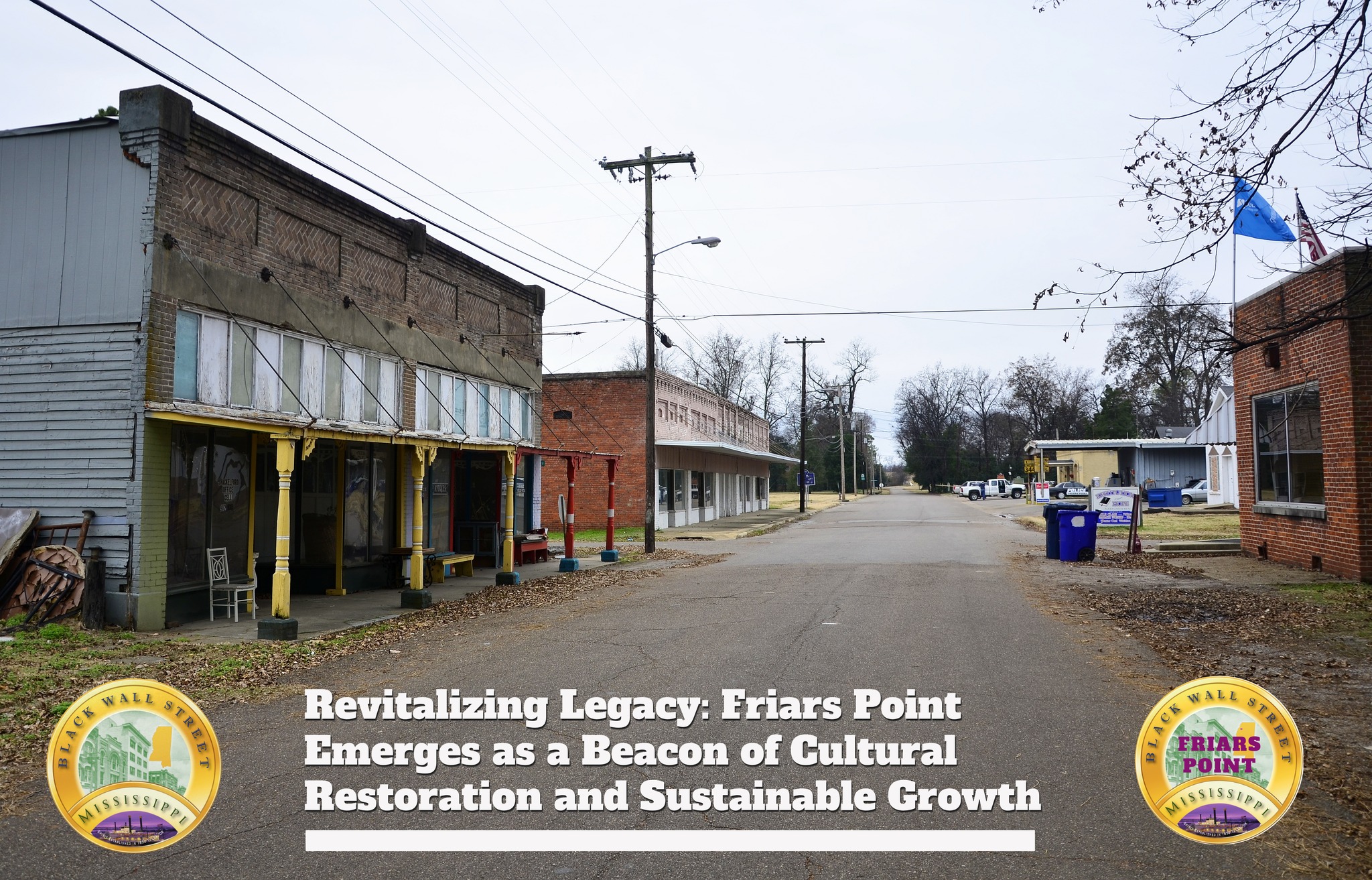
Few places in the Mississippi Delta carry the weight of history quite like Friars Point. Resting quietly along the eastern banks of the Mississippi River, the town has witnessed prosperity and poverty, cultural brilliance and economic abandonment, extraordinary resilience and generations of deferred opportunity. For many Americans, Friars Point exists only as a footnote in regional history. For Melvin Brown Jr., however, it represents something altogether different: one of the nation's most compelling opportunities to demonstrate how historical preservation, economic development, and community leadership can converge to produce enduring transformation.
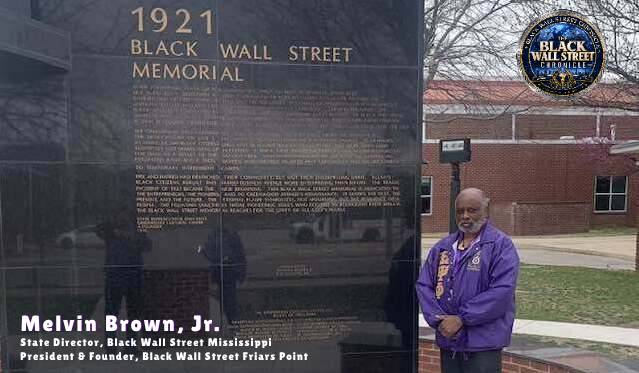
As State Director of Black Wall Street Mississippi, Brown does not describe the work underway as merely another redevelopment initiative. Instead, he speaks of a generational obligation—one that transcends conventional economic development and enters the realm of moral stewardship.
"Our objective has never been simply to renovate buildings," Brown explained during an extensive interview with the *Black Wall Street Chronicle*. "We are rebuilding confidence. We are restoring historical memory. We are creating an economic ecosystem that allows future generations to inherit opportunity instead of decline."
His words reveal a philosophy increasingly reflected throughout the expanding Black Wall Street movement: sustainable prosperity cannot be manufactured through isolated investment alone. Rather, it emerges from the deliberate integration of history, entrepreneurship, education, cultural identity, and strategic partnerships.
It is this comprehensive vision that has become the foundation of the Black Wall Street Friars Point Initiative, a collaborative undertaking designed not only to revitalize one historic Mississippi community but also to establish a replicable framework for rural economic renewal throughout the American South.
Since December 2025, the initiative has evolved from a conceptual framework into a coordinated regional effort supported through close collaboration among BlackWallStreet.org, Black Wall Street Mississippi, Black Wall Street Friars Point, the Omicron Pi Foundation, the Friars Point Economic Development Association, and MBJ Enterprises LLC. Collectively, these organizations have developed an ambitious agenda encompassing historic preservation, workforce preparation, business development, investment attraction, youth leadership, heritage tourism, educational programming, and long-term community sustainability.
Brown believes the significance of the project extends far beyond municipal boundaries.
"Every successful Black Wall Street in American history was built upon local leadership," he observed. "Communities prosper when residents become architects of their own future instead of waiting for outside institutions to determine their destiny."
That conviction has informed virtually every strategic decision made by the coalition.
Rather than pursuing short-term redevelopment projects designed to generate temporary visibility, the partnership has focused on constructing durable institutional capacity capable of supporting decades of economic expansion. Organizational governance structures have been strengthened. Long-range planning documents have been prepared. Community communications have been expanded through newsletters, public presentations, and outreach initiatives intended to cultivate broad civic participation.
Brown frequently returns to one recurring principle.
"Revitalization without organization is temporary. Organization creates continuity. Continuity creates institutions. Institutions create generational wealth."
His remarks underscore what many community development specialists have long argued: lasting transformation depends less upon individual projects than upon the creation of organizations capable of sustaining progress through changing economic and political conditions. The coalition's emphasis on institutional development reflects precisely that understanding. Throughout the past several months, the partnership has invested considerable effort in establishing operational frameworks intended to guide decision-making well into the coming decades. Strategic planning sessions have examined economic development priorities, governance models, preservation objectives, fundraising mechanisms, communications strategies, and implementation timelines extending years beyond the present reporting period.
"Melvin Brown demonstrates that Black economic development is most successful when communities invest in institutions instead of isolated projects. That lesson is relevant far beyond Friars Point. Black politicians that are in position cannot continue to be afraid to move the needle for Black people and Black communities. There is no need for integration when Black people hold the power within themselves. Across the country, including here in Minneapolis—we have opportunities to create lasting economic ecosystems that support Black-owned businesses, preserve neighborhood history, and expand pathways to ownership. The question is not whether these models can work; it is whether we are willing to invest in them.", said, Angela Williams State Director of Black Wall Street Minnesota
According to Brown, this deliberate pace represents intentional discipline rather than hesitation.
"So many communities receive funding for individual projects without first establishing the organizational infrastructure necessary to manage long-term success," he explained. "We're approaching this differently. Before you build the future, you have to build the institutions that will protect that future."

Central to that philosophy is the coalition's flagship undertaking—the Resurrection of Friars Point Project.
Brown describes the initiative not as a single redevelopment program but as a comprehensive community restoration strategy encompassing virtually every dimension of civic life. "The word resurrection was chosen very carefully," he said. "It reflects renewal without forgetting the past. It means recovering what has value while creating something stronger for the next generation." The project integrates neighborhood revitalization, commercial redevelopment, historical preservation, educational partnerships, workforce preparation, tourism planning, business recruitment, and cultural programming within one coordinated framework.
Instead of allowing these priorities to compete for limited resources, the coalition has sought to align them so that each reinforces the others.
Historic buildings become economic assets.
Economic assets create employment.
Employment stabilizes families.
Stable families strengthen neighborhoods.
Healthy neighborhoods preserve history.
History attracts tourism.
Tourism generates investment.
Investment finances additional preservation.
Brown described what he often calls "the circle of community prosperity."
"Every successful Black community in American history understood this relationship," he said. "Commerce supported culture. Culture strengthened education. Education produced leadership. Leadership expanded business ownership. We're simply rebuilding that cycle." The philosophy reflects the broader mission of the Black Wall Street movement itself, which has consistently argued that economic justice cannot be separated from cultural preservation or educational advancement. Communities flourish when these pillars develop together rather than independently.
In Friars Point, that philosophy is no longer theoretical.
Planning documents completed during the current reporting period envision commercial corridors once again serving as centers of entrepreneurship. Vacant properties are being evaluated for adaptive reuse. Redevelopment cost analyses have been prepared. Contractor solicitation packages have been drafted to facilitate future rehabilitation efforts. Investment prospectuses have been assembled for prospective philanthropic partners, public agencies, and private investors.
Each document represents another layer in what Brown describes as "building confidence before construction."
"Investors rarely invest in uncertainty," he said. "Our responsibility is to remove uncertainty by demonstrating careful planning, disciplined leadership, and measurable objectives."
The coalition has therefore emphasized preparation with the same seriousness traditionally reserved for construction itself.
This philosophy also explains the partnership's substantial investment in public communications.
Newsletters, promotional materials, community presentations, branding initiatives, and informational campaigns have been developed not merely for publicity but to cultivate civic ownership.
Brown believes sustainable redevelopment requires residents to view themselves not as spectators but as stakeholders.
"When people understand the vision," he reflected, "they begin to see their own role inside that vision. Community transformation doesn't happen because one organization succeeds. It happens because thousands of individual decisions begin moving in the same direction."
That perspective has helped expand relationships among civic organizations, preservation advocates, educational institutions, veterans' organizations, local businesses, nonprofit leaders, and regional stakeholders who increasingly recognize the interconnected nature of the initiative.
The partnerships continue to evolve, but Brown insists collaboration itself has become one of the project's greatest accomplishments.
"No organization possesses every resource," he said. "The future belongs to communities that learn how to combine expertise instead of competing for recognition."

Among those collaborators, Brown reserves particular appreciation for the Omicron Pi Foundation (Mississippi), whose contribution he characterizes as foundational to the initiative's broader vision. Rather than functioning solely as a philanthropic partner, the Foundation has emerged as a strategic institution helping shape long-term planning, community engagement, educational initiatives, and organizational development. Brown credits the Foundation with encouraging a philosophy that values sustainable capacity-building over short-lived accomplishments, emphasizing disciplined governance, thoughtful investment strategies, and partnerships capable of producing measurable impact for decades. Its leadership has reinforced the belief that revitalization must encompass people as much as places, ensuring that every preservation effort simultaneously strengthens educational opportunity, civic participation, and economic resilience. According to Brown, the Foundation's willingness to invest intellectual leadership alongside financial stewardship has elevated the initiative into a comprehensive model of community restoration rather than a collection of disconnected projects.
The Foundation's emphasis upon disciplined planning has been complemented by the equally indispensable work of the Friars Point Economic Development Association (FPEDA), an organization that Brown characterizes as the operational engine behind many of the initiative's community-centered objectives. Throughout the interview, he repeatedly returned to the Association's capacity to translate ambitious vision into measurable action. While many development organizations understandably concentrate their efforts upon isolated projects or short-term funding opportunities, FPEDA has adopted a far broader mandate—one that integrates neighborhood revitalization, commercial redevelopment, heritage tourism, public engagement, investment attraction, workforce preparation, and strategic planning into a unified framework.
Brown emphasized that successful economic development cannot occur within organizational silos. Instead, every project undertaken by FPEDA is evaluated according to its ability to generate multiple layers of community benefit simultaneously. A restored commercial building must also stimulate entrepreneurship. A tourism initiative must likewise educate visitors while generating revenue for local businesses. A preservation project must inspire civic pride while strengthening educational opportunities for local youth. Such integrated thinking, Brown observed, distinguishes transformative development from incremental improvement.
"FPEDA exists to ensure that every decision contributes to a larger narrative," Brown explained. "We're not interested in isolated accomplishments that look impressive for a season. We're building an institution capable of producing measurable progress for generations."
That philosophy has guided the Association's work in preparing redevelopment strategies, coordinating communications, expanding partnerships, producing investment materials, organizing public engagement campaigns, and establishing implementation schedules that extend years into the future. Brown believes that disciplined planning often receives far less public recognition than ribbon-cutting ceremonies, yet he argues that meticulous preparation ultimately determines whether revitalization efforts succeed or fail. Behind every visible achievement, he noted, exists an invisible architecture of governance, financial management, legal compliance, stakeholder coordination, and strategic sequencing. FPEDA has invested heavily in constructing precisely that architecture, thereby ensuring that future investments rest upon a stable institutional foundation rather than temporary enthusiasm.
Equally instrumental to the initiative has been the entrepreneurial leadership provided by MBJ Enterprises LLC, whose contributions Brown described as bridging the often difficult divide between nonprofit vision and private-sector execution. While community organizations frequently possess compelling ideas, Brown acknowledged that successful implementation requires practical business expertise capable of navigating budgeting, project management, procurement, contractor relations, operational logistics, and long-term financial sustainability. MBJ Enterprises has supplied precisely that dimension, bringing disciplined business methodologies into a community development environment where accountability and measurable outcomes remain paramount. "Business discipline is every bit as important as community passion," Brown remarked. "One without the other leaves tremendous potential unrealized. MBJ Enterprises has helped ensure that our aspirations are supported by practical implementation strategies capable of delivering lasting results."
Its role extends beyond conventional consulting. The company has participated extensively in redevelopment planning, cost analyses, investment prospectuses, contractor solicitation packages, project sequencing, communications strategies, publication development, and long-range implementation planning. Brown views this integration of entrepreneurial expertise as essential to building investor confidence. Public agencies, philanthropic foundations, corporate sponsors, and private donors increasingly seek evidence that community organizations possess not only worthy missions but also the administrative capacity necessary to manage complex, multi-year initiatives responsibly. Through its participation, MBJ Enterprises has helped reinforce that confidence while demonstrating how private enterprise can serve as an indispensable partner in community transformation.
Brown believes the collaboration among Black Wall Street Friars Point, the Omicron Pi Foundation, FPEDA, and MBJ Enterprises represents a model that other underserved communities throughout the nation may ultimately replicate. Rather than assigning leadership to a single organization, the partnership distributes responsibilities according to institutional strengths while maintaining a unified strategic vision. Educational initiatives reinforce economic development. Historic preservation advances tourism. Communications strengthen investment attraction. Workforce preparation supports business recruitment. Every component contributes to a comprehensive ecosystem designed to produce sustained prosperity rather than isolated successes. Perhaps nowhere is that philosophy more profoundly illustrated than in the ongoing preservation of the Historic Friars Point African American Cemetery. Brown's voice noticeably slowed as the conversation turned toward this sacred landscape, reflecting both personal reverence and historical responsibility. For him, the cemetery represents far more than an archival project or preservation initiative. It embodies the accumulated sacrifices, aspirations, and achievements of generations whose lives shaped the Mississippi Delta despite extraordinary adversity.
Williams continued, " The lesson from Friars Point is clear: communities do not prosper because someone hosts an event. We must stop hosting community “events” thinking that is what is going to bring prosperity to Black people. Black communities prosper because someone builds institutions, schools, hospitals, banks, theaters, social clubs, restaurants, housing, and small businesses plus more. Black Wall Street was never simply a place or a moment in history, it was an economic philosophy rooted in ownership, entrepreneurship, and shared prosperity. Now is the time to get back to that. All we need to do is believe in what we’re doing and weed those Black folks out who do not. This has been the biggest problem within our communities, but that is another conversation."
"When we preserve these burial grounds," he reflected thoughtfully, "we are preserving the testimony of people whose stories deserve to remain visible within America's historical consciousness. Their lives built communities. Their labor strengthened this nation. Their sacrifices established opportunities that many now take for granted." Over the past several months, coalition partners have undertaken extensive documentation efforts designed to identify historically significant burials, military veterans, community leaders, educators, entrepreneurs, clergy, civic advocates, and families whose contributions helped define Friars Point's development across multiple generations. Historical research has been accompanied by preservation planning, restoration assessments, volunteer recruitment strategies, sustaining membership programs, cost analyses, and conceptual designs for future commemorative ceremonies recognizing the cemetery's enduring significance.
Brown emphasized that historical preservation extends beyond physical restoration. It requires recovering forgotten narratives, reconnecting descendants with ancestral legacies, and integrating local history into educational programming capable of inspiring future generations. "A cemetery tells the story of an entire community," he explained. "Every name represents a chapter. Every monument represents perseverance. Every family represents another thread in the larger fabric of our shared history."
The coalition envisions transforming the preservation initiative into one of Mississippi's most significant examples of community-based heritage conservation. Rather than viewing the cemetery solely as a place of remembrance, Brown believes it can become an educational resource attracting scholars, genealogists, historians, educators, students, veterans' organizations, preservation specialists, and heritage tourists interested in understanding the African American experience throughout the Mississippi Delta.
Planning has therefore expanded beyond restoration itself to include interpretive materials, educational programming, historical exhibits, digital documentation, guided heritage experiences, volunteer preservation academies, and community events designed to cultivate sustained public engagement. Brown believes such initiatives reinforce an essential principle: communities that understand their history become better equipped to shape their future.
The preservation initiative also reflects a broader commitment to honoring those whose economic contributions often remained unrecognized despite their indispensable role in building regional prosperity. Farmers, laborers, educators, ministers, business owners, veterans, craftsmen, homemakers, and civic leaders collectively established the social and economic foundations upon which later generations continue to build. Brown believes restoring their resting places represents an act of historical justice as much as cultural preservation.
"The cemetery reminds us that economic development begins with remembering who we are," he observed. "Communities that lose their memory eventually lose their direction. Communities that preserve their memory discover renewed purpose."

That philosophy naturally extends into the coalition's commercial redevelopment strategy, where preservation and economic growth function not as competing priorities but as complementary objectives. Among the most promising projects currently under evaluation is the rehabilitation of historic commercial properties, including the landmark building at 301 Washington Street. Brown envisions these structures serving once again as vibrant centers of entrepreneurship, professional services, retail commerce, cultural programming, and community gathering—places where history is not merely displayed, but actively lived through new generations of business ownership and civic engagement.
"These buildings were once symbols of commerce and possibility," he said. "Our responsibility is to restore not only the bricks and mortar, but the spirit of enterprise they once represented."
The vision for commercial restoration reaches far beyond architectural rehabilitation. Brown explained that every historic storefront preserved represents another opportunity to cultivate entrepreneurship, attract investment, generate employment, and restore confidence within the community. Vacant buildings, he noted, often become visible reminders of economic decline. Restored buildings, by contrast, communicate expectation. They signal to residents, investors, visitors, and future business owners that a community has chosen progress over resignation.
"Every occupied storefront changes the psychology of a town," Brown observed. "People begin believing that opportunity is possible because they can literally see it taking shape before their eyes."
That philosophy has informed the coalition's preliminary redevelopment analyses, contractor solicitation packages, engineering assessments, and investment prospectuses. Rather than pursuing restoration for aesthetic purposes alone, the partnership has carefully examined how each commercial property can contribute to a diversified local economy capable of supporting restaurants, professional offices, retail establishments, artisan businesses, cultural venues, educational centers, technology entrepreneurs, and heritage tourism enterprises. Brown believes that economic resilience depends upon diversification rather than dependence upon a single industry or employer. Communities that cultivate multiple streams of commercial activity are better positioned to withstand changing economic conditions while creating opportunities for businesses of varying sizes and sectors.
One of the coalition's distinguishing characteristics has been its deliberate emphasis upon attracting both public and private investment without sacrificing local ownership of the initiative's long-term vision. Brown acknowledged that many historically underserved communities have experienced outside investment that produced short-term construction but limited community benefit. The Black Wall Street Friars Point Initiative seeks a fundamentally different outcome.
"We welcome investment," he explained, "but we also believe investment should strengthen the people who already call this community home. Economic development is most successful when residents become participants in prosperity rather than spectators watching it happen around them."
To that end, coalition partners have developed comprehensive investment packages designed for philanthropic foundations, government agencies, corporate sponsors, financial institutions, community development organizations, and individual donors. These materials outline not only immediate funding needs but also measurable outcomes, accountability mechanisms, phased implementation schedules, and long-term sustainability strategies. Brown believes that transparency remains one of the most persuasive tools available when cultivating investor confidence. Organizations that communicate clearly, report honestly, and demonstrate disciplined stewardship are more likely to secure enduring partnerships than those relying solely upon inspirational rhetoric.
Closely connected to the redevelopment strategy is the coalition's commitment to workforce development, an area Brown regards as indispensable to lasting economic renewal. He argued that community revitalization cannot succeed if educational preparation fails to keep pace with emerging employment opportunities. Consequently, workforce development has been envisioned not as an isolated educational program but as a comprehensive pipeline connecting students, job seekers, educational institutions, employers, entrepreneurs, and community organizations.
"We cannot restore buildings while neglecting the people who will eventually occupy them," Brown remarked. "Our greatest investment will always be human capital."
The initiative has therefore begun developing partnerships with regional educational institutions to explore workforce training opportunities aligned with anticipated economic growth throughout the Mississippi Delta. Preliminary concepts include skilled trades instruction, entrepreneurship education, business management, financial literacy, construction technologies, hospitality management, tourism services, digital communications, nonprofit administration, grant writing, agricultural innovation, and emerging technology applications. Brown emphasized that future employment markets will increasingly reward adaptability, lifelong learning, and interdisciplinary knowledge rather than narrow occupational specialization. "Our objective is not merely to prepare people for today's jobs," he explained. "We want to prepare them for careers that may not yet exist but will emerge as technology, commerce, and society continue evolving."
Equally significant has been the coalition's unwavering investment in youth engagement. Throughout the interview, Brown consistently referred to young people not as future leaders but as present stakeholders whose participation must begin immediately if community revitalization is to endure across generations.
"We often speak about leaving something for our children," he reflected. "I believe we should also be building something with our children."
That distinction has shaped educational programming emphasizing gardening initiatives, leadership development, mentoring relationships, civic responsibility, entrepreneurship, local history, and community service. Brown believes experiential learning fosters a deeper understanding of both personal responsibility and collective achievement. When young people participate directly in preservation projects, neighborhood improvements, historical research, and entrepreneurial activities, they begin viewing themselves as contributors to community transformation rather than passive beneficiaries of adult decision-making.
The gardening initiatives, for example, extend well beyond horticulture. Brown described them as living classrooms where environmental stewardship, nutrition, entrepreneurship, teamwork, and historical understanding intersect. Students learn agricultural techniques while simultaneously exploring the Delta's rich farming heritage and considering how sustainable agriculture may contribute to future economic opportunity. Likewise, mentoring programs emphasize leadership, ethical decision-making, financial responsibility, communication skills, and civic engagement, preparing participants to become informed citizens capable of guiding future community development efforts.
Brown believes one of the initiative's greatest responsibilities lies in reconnecting young people with the remarkable history that surrounds them.
"If a young person grows up believing nothing important ever happened in their hometown, they naturally begin looking elsewhere for significance," he said. "But once they discover that extraordinary people walked these same streets, built businesses here, organized communities here, served their country from here, and overcame tremendous obstacles here, their perspective changes entirely."
This educational philosophy has become particularly influential in the coalition's plans for the North Delta Museum, a project Brown describes as both a preservation initiative and an economic catalyst. Historical research conducted during the reporting period has examined the museum's legal history, organizational development, restoration opportunities, and interpretive potential. Rather than creating a traditional museum focused solely upon static displays, coalition planners envision an interactive cultural institution documenting African American history, entrepreneurship, agriculture, education, civil rights, military service, faith traditions, music, literature, and the commercial evolution of Friars Point and the greater Mississippi Delta.
"The museum should become a place where history speaks to the future," Brown explained. "Visitors should leave not only with greater knowledge of the past but with a clearer understanding of the possibilities that still lie ahead."
Concept papers currently under development propose rotating exhibitions, educational workshops, genealogical research resources, oral history collections, student programs, digital archives, and partnerships with universities, historians, preservation organizations, and cultural institutions throughout the nation. Brown believes that heritage tourism will become an increasingly important component of the Delta's economic future, provided historical resources are interpreted thoughtfully and presented with scholarly rigor.
He envisions the North Delta Museum serving as a destination where families trace ancestral roots, researchers uncover previously overlooked historical narratives, students encounter inspiring stories of perseverance, and visitors gain a richer appreciation for the profound contributions African Americans have made to the region's cultural and economic development. In Brown's view, preserving history is not an exercise in nostalgia but an investment in economic opportunity. Cultural institutions generate tourism. Tourism supports local businesses. Local businesses create employment. Employment strengthens neighborhoods. The cycle of revitalization, he argued, once again comes full circle.
The coalition's commitment to documenting and communicating that story extends naturally into another ambitious undertaking: the publication of the inaugural Black Wall Street Friars Point Magazine. Brown described the publication as considerably more than a newsletter or promotional brochure. Instead, it is envisioned as the flagship publication of the Friars Point Economic Development Association, chronicling the community's ongoing transformation while preserving historical scholarship for future generations. "In many respects," Brown reflected, "every great movement has had a publication that preserved its voice. Newspapers documented the abolition movement. Journals advanced the civil rights movement. Community publications have always served as the historical memory of transformational change. Our magazine will perform that same function for Friars Point."
Editorial plans include investigative features, historical essays, profiles of local entrepreneurs, interviews with community leaders, economic analyses, preservation updates, investment opportunities, educational initiatives, youth accomplishments, and scholarly examinations of the Mississippi Delta's evolving role within the broader narrative of Black economic advancement. Brown believes the magazine will become both a record of accomplishment and an instrument of inspiration, demonstrating to readers across the country that rural revitalization is not only possible but already underway.
As the conversation drew toward the future, Brown's optimism remained firmly grounded in careful planning rather than unchecked idealism. He acknowledged that transformative community development requires patience measured not in months but in decades. Yet he expressed unwavering confidence that the institutional foundations established since December 2025 position Friars Point to become one of the nation's most compelling examples of collaborative, community-led economic renewal. "We're not simply planning for next year," he concluded. "We're planning for 2027, for 2028, for 2030, and for the generation that will inherit the work we begin today. That is how enduring legacies are built."
That long horizon—stretching beyond immediate funding cycles and political attention spans—has become, in Brown’s view, one of the defining distinctions between symbolic revitalization efforts and genuine structural transformation. He emphasized that Friars Point is not being approached as a project with an endpoint, but rather as an evolving civic architecture whose success will be measured in decades, not headlines. “We are not trying to create a moment,” he said. “We are trying to establish a continuum of progress that outlives all of us currently involved in the planning.”
This philosophy directly informs the coalition’s approach to investment attraction, which has been deliberately structured around sustainability rather than immediacy. Rather than focusing exclusively on rapid capital infusion or short-term development bursts, the initiative is cultivating layered financial pathways that include grants, sponsorships, membership ecosystems, public-private partnerships, philanthropic endowments, and community-based investment participation. Brown described this diversified strategy as essential for insulating the initiative from the volatility that often undermines long-term community development efforts. “Communities that depend upon a single source of funding are vulnerable to interruption,” he explained. “We are building a financial ecosystem that can adapt, expand, and endure even as individual funding streams change.” This evolving ecosystem, he noted, is designed not merely to sustain operations but to actively expand opportunity. As investment flows increase, Brown envisions a compounding effect in which restored infrastructure, strengthened institutions, and expanded educational programming reinforce one another. In this model, financial sustainability is not treated as a static condition but as a dynamic process of growth.
By 2027, coalition planners anticipate that early phases of commercial redevelopment will begin transitioning from planning to physical rehabilitation. Properties along key corridors are expected to undergo staged restoration, with priority placed on structures that can immediately support small business incubation, cultural programming, and professional services. Brown emphasized that early visible progress will serve a critical psychological function in reinforcing community confidence. “When people see transformation taking shape in real time, skepticism begins to give way to participation,” he said. “That participation is what ultimately sustains any revitalization effort.” Looking toward 2028 and beyond, the coalition’s long-range framework envisions the expansion of workforce training initiatives into fully operational certification pipelines aligned with regional economic demand. These programs are expected to formalize partnerships with educational institutions, workforce development agencies, and industry stakeholders. Brown explained that such alignment will be crucial in ensuring that residents are not only prepared for available jobs but positioned to compete for emerging opportunities across sectors including construction, hospitality, digital media, heritage tourism, logistics, and entrepreneurship. “Economic justice requires access to preparation,” he said. “Opportunity without readiness is incomplete.”
By 2030, planners envision the North Delta Museum transitioning from conceptual development into a fully realized cultural institution serving as both an educational anchor and a regional tourism catalyst. In Brown’s assessment, the museum will function as a narrative hub—connecting Friars Point to broader national and international conversations about African American history, rural development, and economic resilience. He believes that properly curated cultural institutions possess the capacity to reshape not only how communities are perceived externally, but how residents understand their own identity internally. “When people rediscover their history in a place that respects it,” he said, “they begin to see that place differently. And when they see it differently, they begin to invest in it differently.”
By 2035, the coalition envisions Friars Point operating as a fully integrated model of rural revitalization in which historical preservation, economic development, education, and cultural tourism function as mutually reinforcing systems. In this long-term projection, commercial districts are expected to sustain consistent occupancy, local entrepreneurship is anticipated to expand across multiple sectors, and youth engagement programs are expected to produce a steady pipeline of civic and business leadership. Brown described this vision not as speculative optimism but as disciplined forecasting grounded in incremental execution.
“Every stage we complete makes the next stage more achievable,” he said. “That is the discipline of sustainable development.”
As the interview neared its conclusion, Brown returned once more to the philosophical core of the Black Wall Street Friars Point Initiative: the idea that economic development is inseparable from historical consciousness. He argued that communities attempting to build futures without fully engaging their past often construct progress on unstable foundations. By contrast, Friars Point’s approach seeks to integrate memory and modernization, ensuring that revitalization does not erase history but rather elevates it.
That integration is perhaps most powerfully embodied in the Historic Friars Point African American Cemetery, which Brown described as both a sacred archive and a moral compass for the entire initiative. Each phase of restoration, documentation, and commemoration reinforces the coalition’s belief that the past must remain visible within any credible vision of the future. In this sense, preservation is not a separate track from development but a guiding principle embedded within it. “The past is not behind us,” Brown said. “It is beneath us. It supports everything we are trying to build.”
This sentiment, echoed across multiple facets of the initiative, reflects a broader understanding that Friars Point’s transformation is not simply about economic metrics but about restoring continuity between generations. It is about ensuring that the sacrifices of earlier communities are not only remembered but actively inform the design of future prosperity. As the Black Wall Street Friars Point Initiative continues to evolve, its leaders remain focused on maintaining that balance between ambition and discipline, vision and execution, history and progress. The work, as Brown frequently notes, is both practical and philosophical—requiring as much attention to organizational structure as to moral responsibility. In that synthesis of purpose and planning, Friars Point is gradually emerging not merely as a site of redevelopment, but as a case study in what community-led transformation can look like when anchored in patience, collaboration, and historical awareness.
And for Brown, the measure of success will not be found in any single milestone, but in the gradual emergence of a self-sustaining ecosystem capable of carrying forward long after the initial architects of the effort have stepped aside. “We are building something that should not depend on any one person,” he said in closing. “If we do this correctly, Friars Point will no longer need us in the way it once did. It will have everything it needs to sustain itself.” It is, he suggested, the ultimate goal of any true revitalization effort: not dependence, but independence; not temporary uplift, but enduring structure; not memory alone, but memory transformed into momentum.
And in that transformation, Friars Point may yet come to stand as one of the most instructive examples of what intentional, community-driven development can achieve in the American South—an evolving testament to the belief that history, when properly honored, can become the foundation for a more equitable future.
In the final framing of the initiative, Brown returned to what he described as the “larger architecture” of the Black Wall Street Friars Point effort—its relationship not only to local redevelopment in the Mississippi Delta but to a broader national and global movement of Black economic renewal, institutional memory, and community sovereignty.
He was careful to situate Friars Point within that wider continuum without exaggeration or abstraction. In his view, the strength of the project lies precisely in its groundedness: its insistence that global ideas must still be tested in local soil, in real streets, with real families, and within the lived realities of communities that have historically been excluded from long-term capital investment.
“Movements only become real when they stop being theoretical,” Brown said. “Friars Point is where theory becomes practice.” That statement reflects the guiding ethos of the Black Wall Street Friars Point Initiative, which has increasingly come to function as a working demonstration site for the principles advanced by the broader Black Wall Street Global framework. The emphasis is not on symbolic alignment, but on operational replication—on proving that coordinated development strategies can be implemented in rural environments with the same seriousness and structural integrity often reserved for major metropolitan redevelopment zones.
In Brown’s assessment, this is precisely where Friars Point assumes national significance. The Mississippi Delta, long studied for its historical complexity and economic challenges, becomes in this model not a peripheral geography but a central laboratory for innovation in community-led development. “Rural communities are often treated as if they are waiting to be discovered,” he noted. “But in reality, they are waiting to be resourced, organized, and respected.”
That distinction, he argued, separates extractive development models from restorative ones. Extractive models focus on short-term returns, external control, and limited local capacity building. Restorative models, by contrast, prioritize institutional permanence, community ownership, and intergenerational transfer of both knowledge and opportunity.
The Black Wall Street Friars Point Initiative has, according to Brown, deliberately aligned itself with the latter approach.
As the initiative has expanded, it has also increasingly become a reference point within discussions about how Black Wall Street principles can be adapted across different regions of the United States. The concept, originally rooted in historic economic enclaves of Black entrepreneurship and self-determination, has evolved in contemporary usage into a broader framework for community-based economic sovereignty. In Friars Point, that framework is being interpreted through the lens of historic preservation, rural revitalization, educational expansion, and structured investment development.
A key component of that expansion is the initiative’s public-facing digital and informational infrastructure, including its dedicated portal at [Black Wall Street Friars Point Initiative](https://blackwallstreet.org/friarspoint?utm_source=chatgpt.com), which serves as both an informational hub and a symbolic entry point into the broader project ecosystem. Brown described the platform not merely as a communications tool, but as a “digital extension of community memory and strategic transparency,” designed to allow stakeholders, partners, and the public to follow the evolution of the initiative in real time.
“The digital presence matters because it ensures accountability and accessibility,” he said. “People should be able to see what is being built, how it is being built, and why it matters.” Transparency, in this sense, is not treated as a public relations function but as an ethical obligation. Brown emphasized that communities undertaking long-term redevelopment must remain legible to themselves as well as to external partners. That legibility is what allows trust to develop, and trust, he argued, is the foundational currency of all sustainable development. As the conversation turned toward the future once more, Brown reflected on what he described as the “irreducible test” of the initiative’s success. It is not, he explained, the number of buildings restored, nor the amount of capital raised, nor even the scale of media attention the project may eventually attract. Instead, the true measure will be whether Friars Point becomes a place where residents experience continuity between history, opportunity, and identity.
“A community succeeds when its people no longer feel they have to leave in order to find possibility,” he said. “The goal is to make possibility visible where they already are.” That vision places equal weight on economic infrastructure and cultural continuity. The restoration of commercial corridors, the preservation of sacred burial grounds, the creation of educational institutions, the development of workforce pipelines, and the establishment of cultural programming are all treated as interconnected expressions of a single underlying objective: the reconstruction of civic confidence. Brown described civic confidence as the often-overlooked foundation upon which all other forms of development rest. Without it, investment hesitates, participation declines, and institutions struggle to sustain themselves. With it, however, even modest resources can generate compounding effects over time.
“You can measure buildings,” he said, “but you cannot measure belief as easily. Yet belief is often what determines whether buildings remain occupied, maintained, and valued.” In Friars Point, that belief is being cultivated through deliberate repetition of planning, communication, and visible incremental progress. Each phase of restoration is designed not only to deliver functional outcomes but to reinforce the perception that change is both real and ongoing. As Brown acknowledged, this process requires patience that often runs counter to modern expectations of rapid transformation. Yet he argued that the most durable forms of community development have always unfolded gradually, through layered investment, generational leadership, and sustained institutional commitment.
“Transformation is not an event,” he said. “It is a discipline.”
That discipline, he suggested, is what ultimately connects Friars Point to the broader Black Wall Street movement. Across its various expressions, the movement emphasizes not simply economic success, but the creation of systems capable of sustaining that success beyond individual leadership cycles. It is a philosophy rooted in continuity rather than disruption, structure rather than improvisation.
In that context, Friars Point is positioned not as an endpoint but as an evolving model—one that may inform similar efforts in other communities seeking to balance historical preservation with economic modernization. As the interview concluded, Brown returned to a final reflection on legacy. He spoke not in terms of achievement, but of responsibility. “Every generation inherits something,” he said. “The question is whether they inherit decline, or whether they inherit structure. Our responsibility is to ensure that what we build does not collapse into the next generation’s burden.”
In that statement lies the central premise of the Black Wall Street Friars Point Initiative: that development is not merely about what is constructed, but about what is made possible for those who come after.
If successful, Friars Point will not simply be remembered as a revitalized town in the Mississippi Delta. It will be recognized as a working demonstration of how coordinated vision, disciplined execution, and historical consciousness can converge to produce enduring civic transformation. And in that convergence, Brown believes, the deeper mission of Black Wall Street itself is being reaffirmed—not as a historical memory confined to the past, but as a living framework capable of shaping the future.
For those seeking to follow or engage with the ongoing work of the initiative, additional information is available through the Black Wall Street Friars Point portal at [Black Wall Street Friars Point Initiative](https://blackwallstreet.org/friarspoint?utm_source=chatgpt.com), where updates, developments, and programmatic details continue to be documented as the project evolves.
What remains, Brown suggested in his final remarks, is not conclusion but continuation.
“The work is ongoing,” he said. “And that is exactly as it should be.”