1. Freedom Beyond Emancipation: The Meaning of a New Beginning
Emancipation Opened the Door, but Did Not Complete the Journey
The end of slavery in the United States was one of the most consequential transformations in American history. Yet emancipation did not instantly provide formerly enslaved people with secure homes, sufficient food, education, legal protection, economic independence, or the ability to reunite with loved ones from whom they had been separated. The destruction of slavery created a new historical reality, but it also exposed the enormous social and economic damage that generations of enslavement had imposed on African American families.
For people emerging from slavery, freedom was not merely a legal declaration. It was the opportunity to determine where to live, how to work, whether to attend school, whom to marry, how to raise children, and how to pursue a future without another person claiming ownership over their lives. These rights were fundamental, but their practical exercise depended on conditions that emancipation alone could not guarantee.
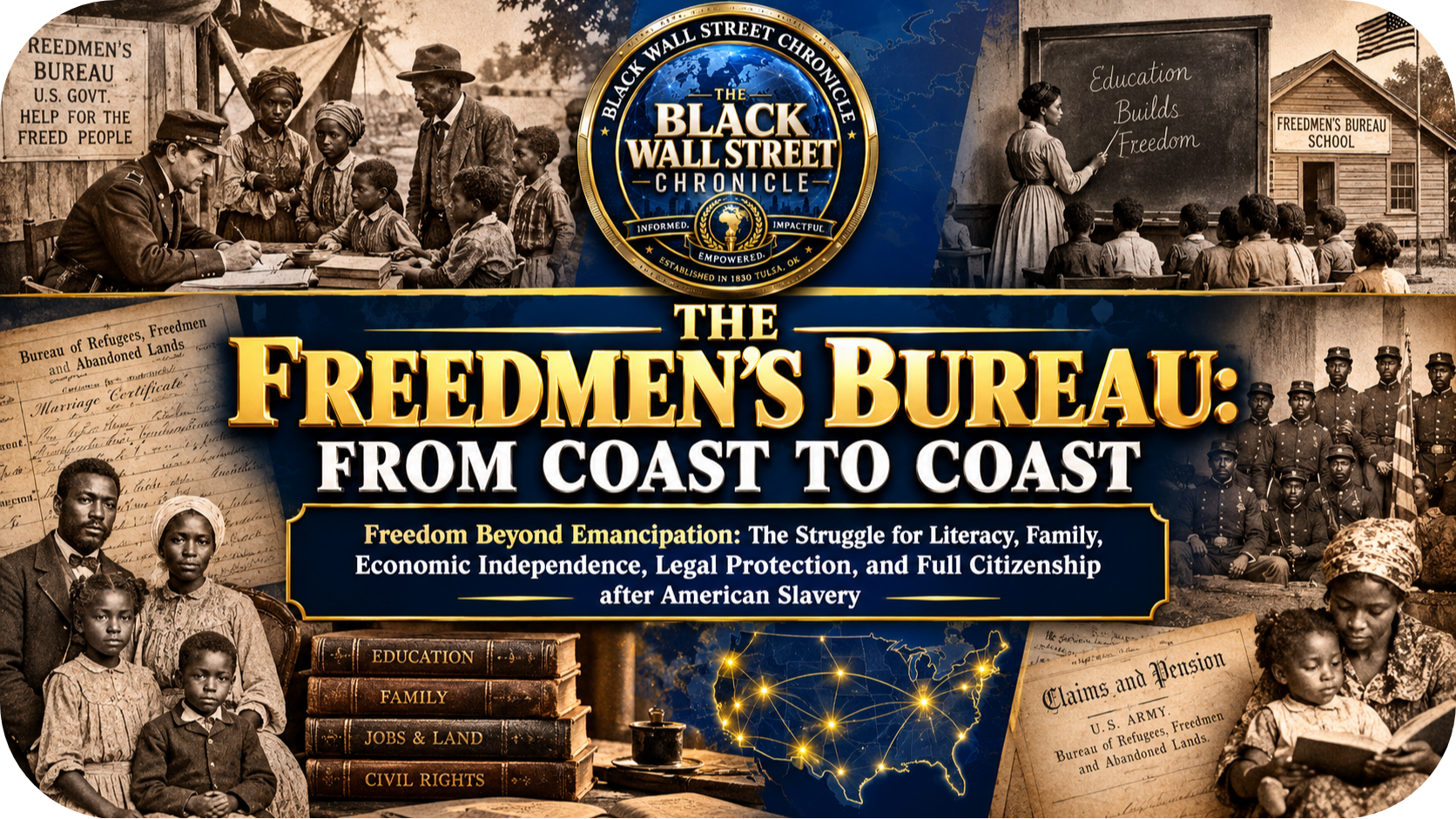
The Freedmen's Bureau, formally known as the Bureau of Refugees, Freedmen, and Abandoned Lands, was created during this extraordinary transition. Established by Congress in March 1865, the Bureau became a federal instrument for addressing urgent humanitarian needs and assisting formerly enslaved people as they attempted to build independent lives. Its work included relief, education, medical assistance, labor supervision, marriage documentation, family searches, and certain forms of legal advocacy.
The Bureau did not possess the resources or authority necessary to eliminate the legacy of slavery. It operated amid political conflict, racial hostility, economic upheaval, and intense disagreement over the meaning of freedom. Nevertheless, its records provide an extraordinary view of people actively pursuing the rights and opportunities that slavery had denied them.
Central historical principle: Formerly enslaved people were not passive recipients of freedom. They searched for relatives, established schools, negotiated wages, formalized marriages, pursued property, challenged injustice, and created institutions of their own. The Bureau's history is inseparable from their initiative and determination.
The People Behind the Records
Bureau documents may appear as lists, certificates, letters, reports, applications, and official correspondence. Behind these administrative forms were human beings confronting questions that remain deeply recognizable: Where is my family? Can I protect my children? Will I be paid for my labor? Can I learn to read? Will the law recognize my marriage? Can I live without fear of violence?
These questions give the Bureau's history its enduring importance. The institution mattered not simply because the federal government created it, but because millions of people were trying to turn a new legal status into the substance of everyday life.
2. The Creation of the Freedmen's Bureau: A Federal Response to Emancipation
A New Agency in a Nation Emerging from War
Congress established the Bureau of Refugees, Freedmen, and Abandoned Lands on March 3, 1865, as the Civil War approached its conclusion. The agency was placed within the War Department and assigned responsibilities connected to refugees, formerly enslaved people, and certain lands abandoned or seized during the conflict.
Major General Oliver Otis Howard was appointed commissioner in May 1865. Headquarters operated in Washington, D.C., while assistant commissioners, sub-assistant commissioners, and field agents carried out work across former Confederate states, certain border states, and the District of Columbia. Local offices became important points of contact for people seeking assistance.
The Bureau emerged from an unprecedented crisis. The war had disrupted transportation, agriculture, public institutions, and local government. Millions of formerly enslaved people were establishing new lives in communities where many white residents opposed racial equality and sought to preserve control over Black labor.
A Broad but Imperfect Mission
The Bureau distributed relief supplies, supported hospitals and temporary camps, assisted in the creation of schools, supervised labor agreements, documented marriages, helped people locate relatives, and addressed complaints involving mistreatment. It also worked on claims by Black soldiers and sailors seeking back pay, bounty payments, and pensions.
These duties were interconnected. A family that lacked food could struggle to keep children in school. A worker denied wages might be unable to pay rent or buy supplies. A person seeking a missing spouse might need transportation, access to records, or assistance communicating with officials in another state.
The Bureau's responsibilities were substantial, but its resources were limited. Its officers were spread across a vast territory, and its effectiveness varied by location, staffing, local cooperation, and the strength of resistance to its activities.
Why the Bureau's Records Matter
The surviving records are not a complete census of African American life after slavery. They were created for administrative purposes, and many people never appeared in them. Some documents were lost, destroyed, incompletely preserved, or never created in the first place.
Even with these limitations, the records preserve names, relationships, occupations, addresses, educational information, labor arrangements, complaints, and personal circumstances that may be difficult to recover from other sources. They are essential evidence for studying emancipation from the perspective of people who lived through it.
3. The Human Crisis of Freedom: Relief, Displacement, and Survival
Freedom in the Midst of Poverty
Emancipation did not erase the poverty produced by slavery. Many freedpeople left bondage without savings, land, livestock, tools, or secure housing. Others remained near plantations because family members lived nearby or because alternative employment and shelter were unavailable.
The war had also destroyed property and disrupted local economies. Food shortages, disease, displacement, and unstable employment affected many communities. For formerly enslaved people, these conditions intersected with the deliberate denial of education, property ownership, and economic opportunity that had characterized slavery.
Food, Clothing, and Temporary Assistance
Bureau offices distributed rations and clothing to people considered destitute and supported relief efforts for refugees and displaced families. In some locations, officials operated or assisted temporary camps, hospitals, and homes. The records of these activities reveal the immediate material needs that accompanied emancipation.
Relief could be lifesaving, but it was not a substitute for secure wages, stable housing, medical care, or land. The Bureau's relief programs were often constrained by budgets, supply shortages, administrative decisions, and competing demands.
Relief as a Bridge to Independence
For many freedpeople, assistance was a means of surviving while they searched for work, reunited with relatives, or established a household. Receiving relief should not be confused with a lack of initiative. People who had been denied control over their labor for generations were attempting to build independence in a society that continued to place severe obstacles in their path.
Bureau records also reveal difficult decisions about who qualified for assistance and how limited resources were distributed. Local officials did not always agree with applicants, and the judgments of individual agents could significantly influence outcomes.
The history of relief therefore involves both the practical value of assistance and the limitations of a system that could not guarantee long-term security for every person who needed help.
4. Literacy as Liberation: The Pursuit of Reading and Writing
Education After a System of Deliberate Exclusion
Literacy held extraordinary significance for African Americans emerging from slavery. In many slaveholding jurisdictions, laws and customs had restricted or discouraged the teaching of enslaved people to read and write. Enforcement varied, but the broader system denied Black people equal access to education and treated independent knowledge as a threat to slaveholders' authority.
Reading could open access to religious texts, newspapers, correspondence, contracts, and public information. Writing could enable a person to communicate with relatives, keep accounts, document an agreement, or petition officials. Arithmetic could help workers evaluate wages and household expenses.
Education was also tied to citizenship. People seeking to participate in civic life needed access to information about laws, public affairs, elections, institutions, and their own rights. Literacy was not the only requirement for effective citizenship, but it could be an important resource for independence and self-advocacy.
The Determination to Learn
Freedpeople pursued education across age groups. Children attended newly established schools, while adults also sought opportunities to learn. People who had spent much of their lives performing demanding physical labor could attend lessons after working hours, despite exhaustion, family obligations, and limited resources.
Adult learners might begin with letters, simple words, or basic arithmetic. Some had to share scarce books and supplies. Others learned in improvised classrooms, churches, private homes, or buildings that were poorly equipped for instruction.
The desire to learn was not simply a response to government programs. African American communities organized, raised funds, supported teachers, and sought schooling because they understood education to be essential to the future of their children and communities.
What School Records Can Reveal
Bureau education records may document school locations, teachers, enrollment, attendance, supplies, buildings, and the condition of educational programs. Not every record names individual students, and surviving materials vary by place and time. Nevertheless, school reports can help researchers reconstruct the rapid development of African American education during Reconstruction.
5. Schools, Teachers, and Communities: Building Institutions for the Future
Schools in a Changing South
The expansion of African American schooling required more than classrooms. Communities needed teachers, books, writing materials, buildings, transportation, funding, and protection from those who opposed Black education. In many places, schools began in churches or other spaces that could be adapted for instruction.
The Bureau worked with benevolent societies, religious organizations, educators, and local communities to support schools. Its education operations collected reports, coordinated assistance, and helped connect local efforts with outside funding and supplies.
Teachers and the Work of Instruction
Teachers worked under difficult conditions. Some taught in crowded rooms with limited materials; others served rural areas where travel and housing were challenging. Teachers could face hostility from people who viewed Black literacy as a threat to the existing racial order.
African American teachers and community leaders were particularly important to the development of lasting educational institutions. Their work helped establish the foundations for schools, churches, mutual aid organizations, and later institutions of higher education.
Education as a Community Project
Families and communities often contributed labor, money, land, or materials to support schooling. Their participation demonstrated that education was not merely an outside reform imposed on the South. It was a priority articulated and pursued by African Americans themselves.
Schooling also served social purposes. It brought people together, created opportunities for intergenerational learning, and helped prepare future teachers, ministers, business owners, and community organizers.
Progress was uneven. A school might close because funds ran out, a teacher departed, a building was damaged, or local opposition became dangerous. The development of a stable public education system would require sustained public commitment well beyond the Bureau's brief existence.
6. Family Reunification: Searching for Loved Ones Across a Broken Nation
The Human Cost of Forced Separation
Enslavement made family life vulnerable to the decisions of enslavers. Husbands and wives could be sold apart. Children could be separated from parents, and siblings could be dispersed across plantations, counties, states, and distant markets. Family relationships endured, but the law often failed to protect them against sale and forced removal.
Emancipation created opportunities for people to search for relatives, but the search could be difficult. A person might know only a first name, a former plantation, a county, a previous owner's surname, or the general direction in which a family member had been taken. Years might have passed since the last contact.
Advertisements, Letters, and Bureau Offices
Formerly enslaved people used newspapers, letters, personal networks, churches, and government offices to seek information about missing relatives. Some advertisements described a person who had been sold away years earlier and asked anyone with information to make contact.
Bureau officers could receive inquiries, forward correspondence, record names, and help connect people with offices in other locations. Transportation assistance could also matter when a relative had been located but lacked the means to travel.
Such efforts were not always successful. People had died, moved, changed surnames, or lost knowledge of earlier family connections. Records could be incomplete, and officials did not have a modern national identification system to connect individuals reliably.
Family Searches as Historical Testimony
Requests for information about missing parents, siblings, spouses, and children show how deeply family reunification shaped the transition to freedom. They also reveal the lasting damage caused by the slave trade and domestic sales.
These records should be read with care. A missing name does not prove that a family member did not exist, and a failed search does not mean the relationship was unimportant. The surviving correspondence represents only a portion of the many searches undertaken.
For genealogists, a family-search letter can provide a rare link between generations. It may identify a former residence, a relative's name, a migration route, or the circumstances of a separation that otherwise would have disappeared from the historical record.
7. Marriage and Legal Recognition: Reclaiming Family Rights
Marriage Under Slavery
Enslaved people formed enduring partnerships and families, often recognizing their unions through religious ceremonies, community practices, or personal commitments. Yet these relationships generally lacked the protections that legal marriage could provide to free people. Enslavers' control over movement and property could override a couple's wishes, and sale could separate partners without meaningful legal recourse.
After emancipation, many couples sought legal recognition for relationships that had lasted for years or decades. Formal recognition could establish a public record of a union and support the legal status of spouses and children.
The Bureau's Marriage Records
Bureau officers and other officials documented marriages, issued certificates, and recorded information about couples and their children. Practices differed by state and locality. Some records describe couples who had lived together for many years; others document newly formed unions after emancipation.
The surviving records are particularly valuable because they can preserve family information that is difficult to find elsewhere. Depending on the document, entries may contain names, dates, places of residence, length of cohabitation, and children's names or numbers.
Marriage Registers as Evidence of Continuity
Legalizing a marriage did not necessarily mean that the relationship had begun after slavery. In many cases, the ceremony or certificate recognized a family that had already existed for years. The act of documentation therefore helped transform longstanding personal commitments into relationships recognized by civil law.
These records must be interpreted with attention to their local context. Documentation procedures differed, and the survival of records is uneven. A couple's absence from a particular register does not prove that they were unmarried or had no family.
The National Archives provides information about the Bureau's marriage records and their historical value. Researchers can begin with its Freedmen's Bureau Marriage Records exhibit and its broader Freedmen's Bureau research guide.
8. Children and Apprenticeship: Protecting the Next Generation
Freedom and Parental Authority
For formerly enslaved parents, freedom included the ability to care for their children without an enslaver claiming authority over the family. Yet the transition was difficult. Poverty, displacement, death, and the absence of secure housing could leave children vulnerable.
Disputes over children's custody and labor became important issues during Reconstruction. Bureau offices sometimes intervened in cases involving apprenticeship agreements, family separation, and allegations that children were being placed in conditions that resembled forced labor.
The Controversy Surrounding Apprenticeship
Apprenticeship was presented in some circumstances as a means of training children in a trade or providing for their maintenance. However, apprenticeship arrangements could also be used to control Black children's labor and undermine parental authority, particularly when local officials favored white employers or former enslavers.
Bureau records may document disputes over the terms of indenture, the identity of guardians or employers, the age of a child, and efforts by parents to regain custody. The details varied by locality, and individual cases require examination of the original documents rather than assumptions based on a single example.
Family Security as a Measure of Freedom
A family's ability to keep children together was central to the meaning of emancipation. Parents wanted to provide food, shelter, education, discipline, affection, and guidance without interference from people who had previously claimed ownership over their lives.
The Bureau's involvement could offer a route to challenge certain abuses, but its officers were not always able to secure the desired outcome. Local courts, laws, customs, and racial attitudes could undermine attempts to protect families.
9. Labor Contracts and Economic Freedom: Negotiating a New Relationship to Work
From Enslaved Labor to Wage and Contract Labor
The destruction of slavery changed the legal status of labor, but it did not eliminate the plantation economy or the desire of landowners to control agricultural production. Formerly enslaved people sought wages, independent farming arrangements, family security, and the freedom to decide where and for whom they would work.
Bureau officers often witnessed or supervised written labor agreements between freedpeople and employers. Contracts could specify wages, housing, food, work duties, the length of employment, and other conditions. The details varied considerably from one agreement to another.
Why Written Agreements Mattered
A written contract could clarify what an employer promised to provide and what a worker was expected to do. It could also create evidence for a complaint if wages were withheld or agreed conditions were not met. For people denied access to formal education, however, reading the document independently could be difficult.
Some contracts included language demanding obedience to employers. Others offered payment arrangements tied to crops, harvests, or particular tasks. A document's existence does not by itself prove that the terms were fair or freely negotiated.
Sharecropping, Debt, and the Limits of Contractual Freedom
Many freedpeople entered sharecropping or tenant-farming arrangements because they lacked land and capital. These systems could allow families to remain on farms and cultivate crops, but they also exposed workers to uncertain harvests, high supply costs, accounting disputes, and debt.
In some circumstances, debt and local legal practices restricted workers' ability to leave an employer. The formal end of slavery therefore coexisted with labor systems that could preserve severe economic dependence.
Bureau records can help historians compare contractual promises with complaints about payment, treatment, housing, and working conditions. They show that economic freedom was not achieved simply by replacing ownership with a written agreement. It required meaningful bargaining power and the ability to enforce rights.
10. Land, Property, and Independence: The Unfinished Question of Economic Power
Why Land Was So Important
Land represented more than a place to live. For farming families, it could provide food, income, a measure of security, and a foundation for passing resources to future generations. Ownership could reduce dependence on former enslavers and give families greater control over their labor.
After the Civil War, questions concerning abandoned and confiscated land became entangled with federal policy, presidential decisions, property claims, and the political struggle over Reconstruction. The Bureau's responsibilities included aspects of managing or supervising certain lands, but its authority was limited and contested.
Expectations and Disappointment
Many freedpeople hoped that emancipation would be accompanied by access to land. Some families settled on land under temporary arrangements or sought assistance through government offices. The future of these arrangements was often uncertain.
The return of property to former owners and the broader failure to distribute land on a large scale left most freedpeople without an independent agricultural base. Many consequently had to negotiate labor arrangements with landowners who retained substantial economic and political power.
Reading Land and Property Records
Applications, leases, correspondence, and property-related reports can help researchers identify land, landlords, tenants, and particular disputes. Some records provide detailed information about a household; others focus primarily on property administration or former owners.
These documents should be examined alongside local deeds, tax records, census schedules, court files, and other sources. A Bureau land record may reveal a family's effort to secure a place to live even if it does not establish that the family ultimately acquired permanent title.
11. Legal Advocacy and Protection: Complaints, Rights, and the Pursuit of Justice
Freedom Required Protection Under Law
The formal abolition of slavery did not immediately create equal treatment under the law. Freedpeople faced wage disputes, threats, physical assaults, discriminatory practices, restrictions on movement, and other forms of coercion. In many communities, local authorities were unwilling or unable to protect Black residents on equal terms.
Bureau offices received complaints and correspondence concerning mistreatment, labor disagreements, violence, family disputes, and other matters affecting freedpeople. Officers sometimes investigated, communicated with local officials, helped parties negotiate, or referred matters to military or civil authorities.
Complaints as Acts of Self-Advocacy
When a person filed a complaint or wrote to a federal official, the act itself could represent an assertion of rights. People were seeking recognition that their lives, wages, families, and physical safety were no longer subject to another person's unrestricted control.
Not every complaint resulted in a remedy. Records may document allegations, investigations, correspondence, or recommendations without showing a final resolution. Researchers should distinguish between what a person reported, what an official concluded, and what can be independently established.
Violence and the Limits of Federal Intervention
Bureau records document cases of intimidation and violence against freedpeople and individuals who cooperated with federal authorities. Some people were threatened or attacked for asserting their rights, reporting abuse, or refusing to accept an employer's demands.
The ability of an individual agent to respond depended on local circumstances, military support, available personnel, and broader federal policy. Where local resistance was intense, an office might have difficulty protecting witnesses, securing testimony, or ensuring that a complaint received a fair hearing.
These records reveal both the possibilities and the limitations of federal advocacy during Reconstruction. They also caution against interpreting freedom solely through statutes while overlooking whether people could safely exercise their rights.
12. Health, Relief, and Survival: Medical Care After Slavery
Medical Needs in the Postwar South
War, poverty, displacement, inadequate housing, and limited access to medical services created serious health challenges. Formerly enslaved people often entered freedom without the financial resources necessary to secure care independently.
The Bureau operated or supported hospitals, temporary medical facilities, and relief programs in some locations. Its records include reports relating to medical personnel, patients, vaccinations, supplies, and institutional conditions.
Medical Records as Social History
Medical documents can provide evidence about the health needs of freedpeople and the resources available to meet them. They may also reveal how officials understood disease, poverty, disability, and the needs of families during the transition from slavery.
Such records require careful interpretation. Administrative categories and nineteenth-century medical terminology do not always correspond directly to present-day diagnoses or understandings of health.
Beyond Emergency Relief
A hospital visit or ration distribution could address an immediate crisis without resolving the underlying conditions that caused it. Sustainable health depended on housing, nutrition, sanitation, income, community infrastructure, and continuing access to care.
The Bureau's medical work was therefore part of a larger struggle to establish the basic conditions in which freedom could be lived. Its limited capacity illustrates how difficult it was to rebuild social institutions in a region transformed by war and emancipation.
13. Black Veterans and Their Families: Claims for Pay, Bounties, and Pensions
Military Service and the Claim to Citizenship
African American soldiers and sailors played an important role in the Union war effort. Military service could provide income, create new relationships and experiences, and strengthen claims to recognition as citizens. Yet veterans and their families sometimes encountered difficulties obtaining the payments or benefits they were owed.
The Bureau undertook work involving claims for back pay, bounty payments, and pensions. These matters could require documents establishing military service, identity, family relationships, or entitlement to a benefit.
Claims and the Importance of Documentation
A claim might involve a veteran who had not received money due for service, or a family member seeking a benefit connected to a soldier who had died. The process could be difficult for people who lacked paperwork, lived far from an office, or were unfamiliar with administrative procedures.
Claims records can identify names, military units, family members, addresses, and circumstances surrounding an application. They may connect military records to civilian life and provide clues for genealogical research.
Service, Sacrifice, and Unfinished Equality
The pursuit of military benefits illustrates the distance between a promise of equal citizenship and the administrative and social barriers that Black Americans continued to face. A veteran's service did not automatically guarantee that a claim would be processed quickly or successfully.
The Bureau's claims work forms part of the larger story of African American efforts to secure recognition, compensation, and protection under the law after the Civil War.
14. Women and the Meaning of Freedom: Work, Family, and Legal Identity
Women's Labor and Family Responsibilities
African American women faced the challenge of rebuilding family life while navigating a labor market shaped by slavery and racial inequality. Women worked in agriculture, domestic service, laundry, childcare, food production, and other occupations. Their labor helped sustain households and communities, although it was often undervalued or poorly compensated.
Freedom offered new possibilities for choosing employment, protecting children, formalizing marriages, and managing household affairs. Yet women frequently faced pressure to accept low wages or work under conditions that limited their independence.
Family Rights and the Recognition of Marriage
Marriage documentation could help establish a family's legal identity. Records naming spouses and children may be especially important for reconstructing women's lives, since many other historical sources record men more consistently or identify women only through their relationships to male relatives.
Bureau records do not provide a complete account of women's experiences. A woman may appear in a marriage register, relief list, labor agreement, medical report, or family inquiry, but these documents often record only the information needed for a specific administrative purpose.
Women as Decision-Makers
Women should not be understood solely as dependents within the family. They made decisions about work, children, migration, relationships, and survival. They also contributed to the creation of churches, schools, mutual aid networks, and community institutions.
Research that combines Bureau documents with census records, court proceedings, newspapers, church records, and oral histories can help restore a fuller picture of women's experiences and the choices they made during Reconstruction.
15. Reconstruction and Political Rights: Freedom in a Contested Nation
Rebuilding the Southern Political Order
Reconstruction involved a struggle over the future of the United States and the meaning of emancipation. Questions about citizenship, civil rights, voting, labor, property, education, and the relationship between federal and state authority shaped the period.
Constitutional amendments abolished slavery, established national citizenship and equal protection principles, and prohibited racial discrimination in voting for male citizens. The practical realization of these protections, however, faced intense opposition and uneven enforcement.
The Bureau's Role in a Larger Transformation
The Bureau was one part of the federal government's Reconstruction effort. Its day-to-day responsibilities were often practical: assisting families, recording contracts, supporting schools, addressing complaints, and helping people navigate institutions. Those activities nevertheless occurred within a larger contest over the rights and status of formerly enslaved people.
Bureau officers did not all share identical views, and local practices varied. The agency's effectiveness depended on political decisions and the resources made available to it. Its work could assist freedpeople while still reflecting the limitations and prejudices of nineteenth-century institutions.
Freedom and the Problem of Enforcement
Legal declarations are most effective when people can exercise their rights without intimidation and can seek meaningful remedies when those rights are violated. During Reconstruction, violence, discriminatory local practices, and economic dependence frequently undermined that ideal.
The Bureau's history illustrates why civil rights cannot be understood solely as words in legislation. Their impact depends on institutions, resources, public commitment, and the ability of ordinary people to claim protection in daily life.
16. Regional Records and Local Histories: From Arkansas and Florida to Mississippi, Tennessee, Virginia, and Washington, D.C.
Why Local Research Matters
The Bureau operated across a broad geographic area, but its records were created by particular offices responding to local circumstances. State laws, agricultural systems, migration patterns, population movements, and the conduct of individual officials influenced what was documented and how cases were handled.
Researchers should therefore avoid assuming that one state's records represent the experiences of every freedperson. A marriage register from one jurisdiction may contain information not preserved in another. A labor contract in one county may differ significantly from an agreement made elsewhere.
Arkansas
Arkansas records can support research into families who lived in the state after emancipation, including marriage documentation and the search for relatives. Researchers should compare names and locations with census schedules, county records, newspapers, church documents, and other surviving sources.
A useful starting point is Freedmen's Bureau marriage records for Arkansas.
Florida
Florida's records provide another entry point for studying the postwar transition. Researchers may encounter documentation related to local offices, relief, employment, family life, and other matters affecting freedpeople. The exact types of records available differ by locality and archival series.
Consult Freedmen's Bureau resources for Florida and Florida Freedmen research resources.
Mississippi
Mississippi's history of plantation agriculture and emancipation makes local research especially important for understanding labor, family reconstruction, education, and the pursuit of economic independence. Researchers should examine individual records rather than assume that every county or community experienced Reconstruction in the same way.
Begin with Mississippi Freedmen's Bureau marriage records.
Tennessee
Tennessee marriage records may preserve information about couples who formalized unions after slavery, including relationships that had already endured for years. These records can help researchers trace households and connect family members to other documents.
See Tennessee Freedmen's Bureau marriage records.
Virginia
Virginia records can be valuable for tracing people who remained in the state or migrated elsewhere after emancipation. Letters and family inquiries sometimes identify relatives who had been separated for many years. Such documents can provide leads for research across county and state boundaries.
One local resource is Freedmen's Bureau material relating to Gloucester, Virginia.
Washington, D.C.
Washington, D.C., was important both as the location of Bureau headquarters and as a place where freedpeople established homes and sought recognition of family relationships. Headquarters marriage records gathered information from multiple locations, making them useful for research beyond the District itself.
Consult Washington, D.C., Freedmen's Bureau marriage records.
Research note: Online transcription sites and genealogy pages are useful discovery tools, but transcriptions can contain omissions or errors. Whenever possible, compare a transcription with the original document image and the National Archives' description of the relevant record series.
17. Resistance and the Bureau's Limitations: Why Freedom Remained Vulnerable
Opposition to Black Independence
The Bureau operated in an environment where many white Southerners resisted changes to racial hierarchy and labor relations. Some landowners wanted to retain control over workers; some local officials opposed federal intervention; and some communities used intimidation or violence to discourage African Americans from asserting their rights.
Resistance could take many forms, including refusing to honor labor agreements, interfering with schooling, threatening people who filed complaints, or attempting to control where freedpeople lived and worked. The forms and severity of opposition differed across locations and over time.
Structural Limitations
The Bureau faced limited funding, a small workforce relative to the scale of the problem, difficult transportation, uneven local cooperation, and changing political support. Its agents could not be present everywhere, and they could not permanently resolve every dispute that came before them.
The Bureau also operated within nineteenth-century assumptions about race, gender, work, and social order. Its officers did not always agree with freedpeople's goals, and some decisions favored employers or local authorities rather than the people seeking help.
Assessing Success and Failure
A balanced assessment must distinguish between the Bureau's accomplishments, the limits of its authority, and the larger political decisions that shaped Reconstruction. The creation of schools, preservation of family records, assistance with marriages, and handling of complaints were significant achievements. They did not, however, produce universal access to land, permanent economic security, or lasting protection from racial violence.
The Bureau should neither be treated as a complete solution to the aftermath of slavery nor dismissed because it failed to accomplish everything its supporters hoped. Its records provide evidence of both meaningful intervention and profound unfinished work.
18. The Bureau's Decline and Closure: The End of an Agency, Not the End of the Struggle
Withdrawal and Reduced Capacity
The Bureau's operations changed over time. Much of its most active field work occurred between 1865 and 1868, although some functions continued beyond that period. As political priorities shifted and federal involvement diminished, the agency's capacity to support freedpeople was reduced.
Congress had established the Bureau as a response to the crisis of emancipation, but it did not become a permanent institution capable of guaranteeing equality or economic independence. Its future depended on political support, appropriations, and decisions about the federal government's responsibility for Reconstruction.
Formal Abolition in 1872
The Bureau was formally abolished in 1872, with certain remaining responsibilities transferred to other federal offices. The closure marked the end of an important federal agency, but the social, economic, and political challenges it had confronted did not disappear.
Formerly enslaved people continued to build families, establish businesses, organize churches, pursue education, and seek land and secure employment. They also continued to confront racial discrimination, violence, and economic dependence.
The Importance of Institutional Continuity
The Bureau's short life illustrates the consequences of ending a program before the conditions that made it necessary have been resolved. Emergency relief can address immediate needs, but lasting change generally requires stable institutions, sustained resources, enforceable rights, and long-term political commitment.
The records that survived the Bureau's closure became a historical resource for later generations. They allow researchers to recover names and experiences from a period when many African Americans were entering written public records in new ways.
19. Genealogy and Historical Memory: Recovering Names, Relationships, and Lives
From Administrative Records to Family History
Freedmen's Bureau records are among the important resources for researching African American family history during and after emancipation. They can provide evidence about marriages, children, former residences, employment, military service, relief, and family searches.
Their value is especially great when slavery disrupted the transmission of family information or when earlier records identified people by first name, by an enslaver's surname, or through property inventories rather than as independent members of a family.
How to Begin a Search
- Start with known information. Record names, approximate birth years, locations, spouses, children, and family stories. Note spelling variations and uncertainty.
- Search the National Archives guide. Identify the state and local office that may have handled the matter. Different record series serve different research purposes.
- Look for more than one record type. Marriage registers, labor contracts, school reports, complaint records, relief lists, military claims, and correspondence may provide complementary details.
- Compare with other sources. Use census records, vital records, deeds, probate files, church registers, newspapers, military records, and local histories when available.
- Check original images. Transcriptions are useful starting points, but handwritten names and dates can be difficult to read. Confirm important details against the original whenever possible.
- Document uncertainty. Similar names do not necessarily identify the same person. Record the evidence for each conclusion and distinguish verified facts from hypotheses.
What the Records Cannot Tell Us
No single collection provides a complete record of every formerly enslaved person or every family. Some offices created more extensive documentation than others, and many records did not survive. People also moved beyond the places where their original records were created.
A missing record is not evidence that a person did not exist, that a relationship was not genuine, or that a family did not pursue assistance. The absence of documentation should be treated as a limitation of the archive rather than a judgment about the importance of the person or event.
Preserving Historical Memory
Family research can reconnect descendants with people whose lives were obscured by enslavement, displacement, and incomplete documentation. Each recovered name or relationship contributes to a fuller account of African American history.
The task is not only to identify ancestors but also to understand the conditions in which they lived, the choices they made, and the communities they helped create. Bureau records become most meaningful when read as evidence of people with families, ambitions, fears, skills, and plans for the future.
20. The Continuing Legacy of Freedom: What the Freedmen's Bureau Means Today
A Record of the Transition from Slavery to Freedom
The Freedmen's Bureau occupied a limited period in American history, but the questions it confronted remain central to understanding emancipation and Reconstruction. What does freedom mean when a person lacks secure housing, education, employment, legal protection, or the ability to keep a family together? What responsibilities do public institutions have when an entire population emerges from a system that denied its members basic rights?
The Bureau's work addressed some immediate needs, but the agency could not eliminate the long-term effects of slavery. Its records demonstrate both the value of public assistance and the limits of temporary intervention when deeper economic and social inequalities remain.
The Enduring Importance of Literacy
The determination of freedpeople to learn illustrates the connection between knowledge and self-determination. Education offered tools for communication, economic activity, civic participation, and family advancement. The schools established during Reconstruction were part of a wider African American commitment to education that continued long after the Bureau closed.
The Enduring Importance of Family
Marriage certificates and family-search letters show that legal freedom was deeply personal. People wanted to find loved ones, reunite households, protect children, and have their relationships recognized. These priorities are central to the history of emancipation because they reveal the everyday meaning of freedom.
The Enduring Importance of Economic Independence
Labor agreements, property applications, and complaints reveal the struggle to transform emancipation into economic security. Freedom from legal ownership did not automatically provide access to land, fair wages, capital, or equal bargaining power. Many freedpeople had to pursue these resources within systems that continued to favor white landowners and employers.
Why the Archive Must Be Preserved
The surviving Bureau records are more than paperwork from a discontinued federal agency. They preserve evidence of a vast historical transition and of people whose lives were often poorly represented in earlier official records.
Responsible historical research requires attention to both what the records reveal and what they cannot establish. It requires reading documents in context, comparing independent sources, acknowledging gaps, and treating the people named in the records as human beings rather than merely entries in a database.
Conclusion: The history of the Freedmen's Bureau is a history of urgent need, institutional limits, and determined action. The Bureau helped document marriages, support schools, provide relief, supervise labor arrangements, and assist people seeking family members or legal remedies. Its achievements were incomplete, but its records preserve the aspirations and struggles of people transforming emancipation into daily life.
At the center of this history are freedpeople themselves: parents searching for children, couples seeking recognition, workers negotiating wages, adults learning to read, veterans pursuing benefits, and communities building institutions for future generations. Their efforts remain essential to understanding the meaning of freedom after slavery.
Research Sources and Further Reading
The following sources provide historical context, archival descriptions, state-specific records, marriage documentation, and genealogical research leads. Online transcription and genealogy sites should be used alongside original records and authoritative archival descriptions.
National Archives and Federal Records
- National Archives — The Freedmen's Bureau
- National Archives — The Freedmen's Bureau: Educational Resources
- National Archives — Freedmen's Bureau Records: An Overview
- National Archives — Marriage Registers of Freedmen
- National Archives — Select Freedmen's Bureau Records
- National Archives — African American Reference Reports
- National Archives Museum — Freedmen's Bureau Marriage Records
Freedmen's Bureau Online and State Resources
- Freedmen's Bureau Online — Main Research Site
- Arkansas Marriage Records
- Florida Freedmen's Bureau Resources
- Mississippi Marriage Records
- Tennessee Marriage Records
- Washington, D.C., Marriage Records
- Gloucester, Virginia, Freedmen's Bureau Resources
Additional Genealogy and Historical Resources
- RootsWeb Genealogy Resource Supplied for Further Research
- Freedmen of the Frontier
- Florida African American Genealogy Resource
- Historical Reference Link Supplied for Further Research
- Historical Record Group 105 Reference Link Supplied for Further Research
- RootsWeb — Canada and Freedmen Research Reference
- National Archives — Current Freedmen's Bureau Research Guide
Research Guidance
Published for the Black Wall Street Slavery Project. This educational article is intended to support historical understanding and further research into emancipation, Reconstruction, and the lives of formerly enslaved people. The historical links supplied for this article may have moved, changed, or become unavailable. Where an older URL does not load, use the National Archives' current Freedmen's Bureau guide to locate the relevant record series and archival descriptions. The availability and detail of surviving records differ by state, office, date, and document type.